


On this page20 sections
- What Are the Best Beaches in Northern Portugal (Costa Verde)?
- Where Should You Swim Around Porto?
- What Are the Best Beaches in Central Portugal?
- Which Lisbon Coast Beaches Are Worth Your Time?
- Are the Alentejo Beaches Really That Empty?
- What Are the Best Beaches in the Algarve for 2026?
- Portugal Beach Comparison Table
- Which Beaches Are Best for Families, Surfing, and Seclusion?
- Final Thoughts on the Best Beaches in Portugal 2026
If you’re flying in from the US this summer, you’re about to hit one of Europe’s most underrated coastlines. The best beaches in Portugal 2026 stretch across roughly 500 miles of Atlantic shore, and Portugal earned over 350 coastal Blue Flag beaches for 2025 (Blue Flag / FEE), one of the highest counts on Earth per capita. I live up north in the Minho, and I’ve swum most of these. Below I’ve ranked them the way you’ll actually road-trip them: north to south, from cold-but-empty Costa Verde down to the warm, golden Algarve. No filler, just where to go and why. Planning to drive the south end? See our Algarve road trip itinerary.
Key Takeaways:
- Portugal holds over 350 coastal Blue Flag beaches (Blue Flag, 2025), among the most worldwide.
- The Algarve has the warmest, calmest water; the north and Lisbon coast run colder with real Atlantic swell.
- Summer sea temps range from about 63°F (17°C) up north to 73°F (23°C) in the Algarve (IPMA).
- Best beach season is June through September, with July and August busiest.
What Are the Best Beaches in Northern Portugal (Costa Verde)?
Northern Portugal’s Costa Verde is where locals go and tourists forget to. The water’s cold, honestly, hovering near 63–66°F (17–19°C) in summer (IPMA), but the beaches are wide, wild, and cheap. This stretch runs from the Spanish border down to Porto, and it’s my home turf.
Moledo sits right at the mouth of the Minho river, with a photogenic offshore fort and long tidal flats that families love. Praia de Âncora, just south, is a working fishing town with a calm river beach kids can wade in safely. Then there’s Ofir near Esposende, a pine-backed dune beach with some of the softest sand in the north.
Here’s my insider note: nobody tells Americans about these. You’ll pay $2 (~€1.85) for an espresso and share a mile of sand with maybe twenty people in July. Pair a beach day with the mountains inland at the mountains of Peneda-Gerês. For more on this stretch, see our full guide to the best beaches near Porto.
Where Should You Swim Around Porto?
Porto’s beaches sit a quick metro or Uber ride from the city center, which makes them the easiest urban swim in the country. Water runs cool, around 64°F (18°C) in August (IPMA), so pack accordingly. The Porto district holds dozens of Blue Flag sites (Blue Flag), reflecting solid water quality despite the northern chill.
Matosinhos
Matosinhos is Porto’s main beach: a broad, sandy crescent famous for surf schools and, right behind it, the best grilled seafood in the region. You can take the metro straight there. It’s not pretty in a postcard way, but it’s genuinely fun and very local.
Miramar
A few stops south, Praia de Miramar has the tiny Senhor da Pedra chapel sitting on a rock in the surf. It’s one of the most photographed spots north of Lisbon, and it’s calmer than Matosinhos. Great for a sunset walk after a beach afternoon. Planning a base here? Booking.com beachfront hotels
What Are the Best Beaches in Central Portugal?
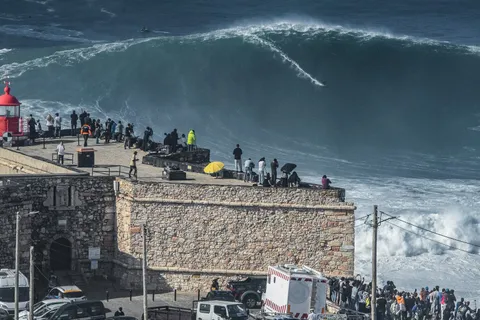
Central Portugal (the Centro region) is surf country and dramatic scenery. This coast produced the biggest wave ever surfed, an 86-foot monster ridden at Nazáre in 2020 (Guinness World Records). Summer water sits near 66–68°F (19–20°C) (IPMA), and the beaches here mix family-friendly bays with serious swell.
Nazáre
Nazáre is two beaches in one. The town beach is calm and family-safe in summer, lined with women still selling dried fish in traditional dress. Around the headland, Praia do Norte is where the giant winter waves break. In July, it’s swimmable and spectacular.
Peniche and Baleal
Baleal, near Peniche, is Portugal’s beginner-surf capital. A sandy causeway connects to a little island, with gentle beach breaks on both sides. If you’ve never surfed, this is where to learn. Lessons run about $35 (~€32) for two hours.
São Pedro de Moel
São Pedro de Moel is a quiet pine-forest resort beach south of Nazáre. Locals from Leiria have summered here for generations. It’s clean, low-key, and far off the American radar, which is exactly the point. More like this at Portugal’s hidden gems.
Which Lisbon Coast Beaches Are Worth Your Time?
The Lisbon coast packs incredible variety within an hour of the capital. Portugal hosted a record 30-plus million guests in 2023 (INE), and much of that spills onto these beaches. Water’s brisk here, roughly 64–67°F (18–19°C) in summer (IPMA).
Costa da Caparica is a 15-mile ribbon of sand just across the bridge from Lisbon. A summer mini-train runs down its length, and the farther you ride, the emptier and wilder it gets. Guincho, near Cascais, is a wind-whipped surf and kitesurf beach with big Sintra-mountain views behind it. Praia Grande below Sintra has consistent waves and dramatic cliffs.
Pair any of these with a day exploring Sintra and its palaces. My tip: go to Caparica for swimming and Guincho only if you like wind. Guincho’s beautiful, but it’ll sandblast your legs on a breezy afternoon.
Are the Alentejo Beaches Really That Empty?
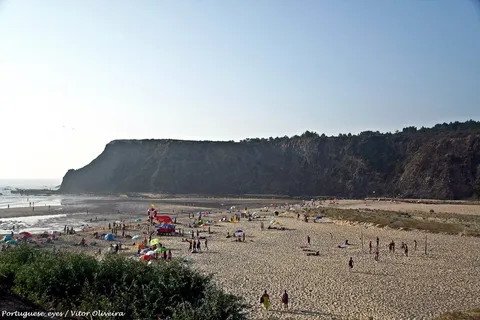
Yes, and that’s the whole appeal. The Alentejo coast is Portugal’s least-developed shoreline, protected in part by the Southwest Alentejo and Vicentine Coast Natural Park (apambiente.pt). You’ll find dramatic cliffs, few crowds, and water around 66–69°F (19–21°C) (IPMA). It feels a decade behind the Algarve, in the best way.
Comporta has become the chic escape, rice paddies meeting endless white dunes, popular with a low-key European crowd. It’s stylish but still calm. Further south, Zambujeira do Mar is a clifftop village with a stunning cove beach below and a laid-back surf scene. Just south of the village, Praia dos Alteirinhos is also one of the official naturist beaches in Portugal, if that’s your thing. Prices here beat the Algarve, and the sunsets are unreal. This is where I send friends who want space to breathe.
What Are the Best Beaches in the Algarve for 2026?
The Algarve is the postcard: golden cliffs, warm water, and calm coves. It’s the warmest swimming in mainland Portugal, near 71–73°F (22–23°C) in August (IPMA), and the Faro district holds one of the country’s densest clusters of Blue Flag beaches (Blue Flag). This is peak-summer paradise, so book early. If the south is where you’re headed, our ranking of the best beaches in the Algarve maps all 15 with parking and access notes.
Praia da Marinha and Benagil
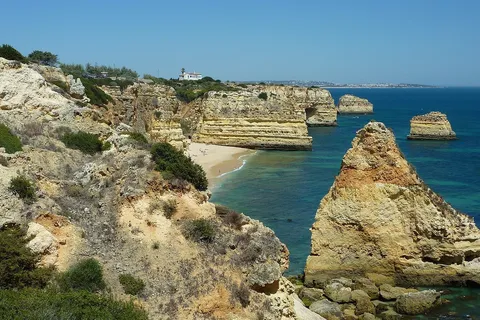
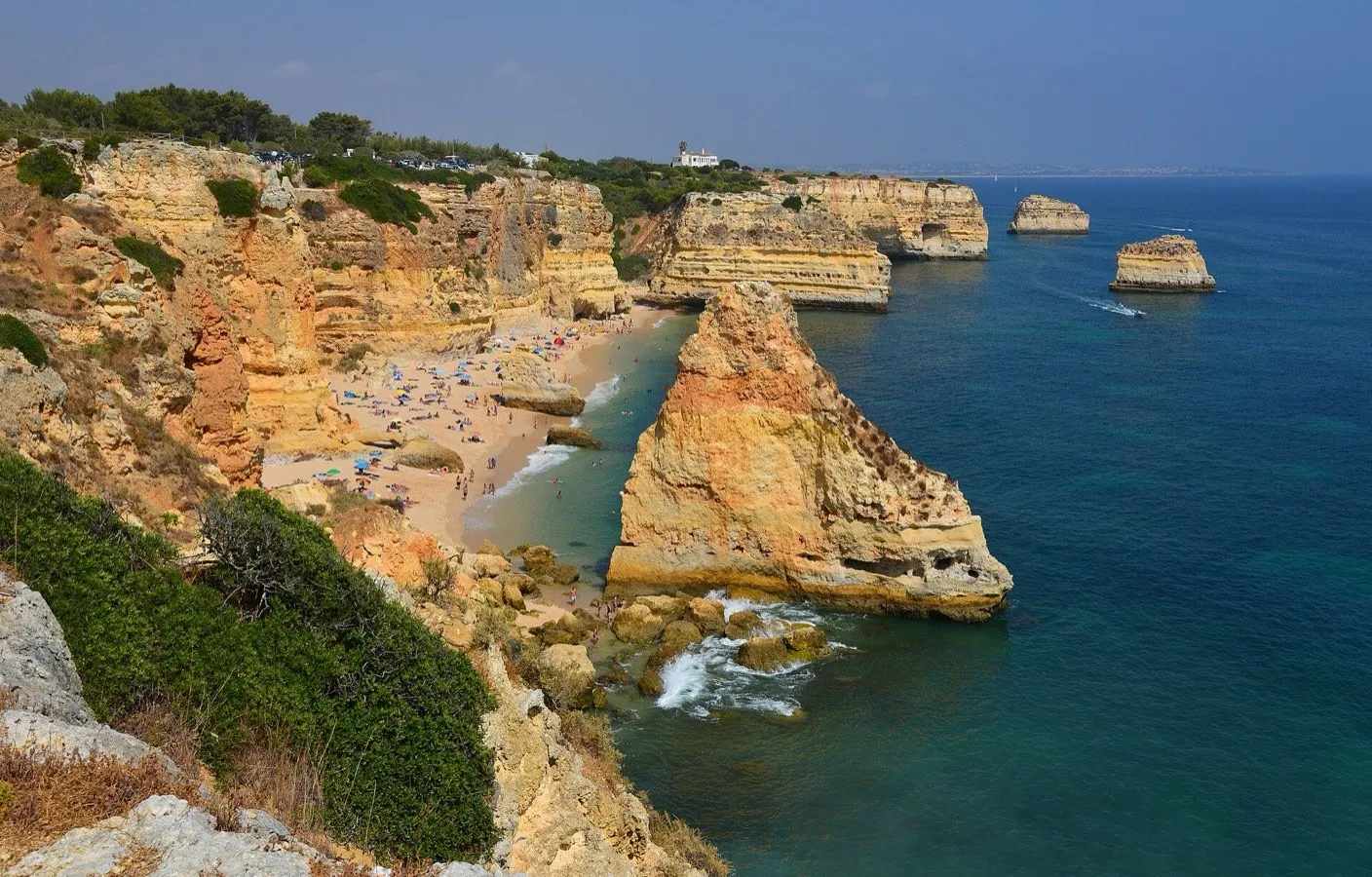
Praia da Marinha ranks among Europe’s most beautiful beaches, all limestone arches and turquoise water. Nearby Benagil has the famous sea cave with a hole in its roof; reach it by kayak or boat tour, not by swimming, please. Rip currents there are real.
Meia Praia and Praia da Rocha
Meia Praia in Lagos is a long, flat, family-perfect beach with gentle entry and plenty of space. Praia da Rocha in Portimão is the big, lively resort beach: sunbeds, bars, and a boardwalk. Great if you want energy and amenities on tap.
Tavira and Ilha de Tavira
Out east, Ilha de Tavira is a barrier island reached by a short ferry. The water’s warmer and calmer, the sand goes on forever, and the town of Tavira behind it is one of the loveliest in the south. My pick for the eastern Algarve. Renting wheels to explore it all? Discover cars rental. For the full region, see our complete Algarve guide.
Portugal Beach Comparison Table
| Beach | Region | Best For | Water Temp (Summer) | Blue Flag |
|---|---|---|---|---|
| Moledo | Minho / Costa Verde | Wide, empty sand | 63°F (17°C) | Yes |
| Ofir | Costa Verde | Soft dunes, families | 64°F (18°C) | Yes |
| Matosinhos | Porto | City surf, seafood | 64°F (18°C) | Yes |
| Miramar | Porto | Photos, sunsets | 64°F (18°C) | Yes |
| Nazáre | Centro | Big-wave scenery | 67°F (19°C) | Yes |
| Baleal / Peniche | Centro | Learning to surf | 66°F (19°C) | Yes |
| Costa da Caparica | Lisbon | Easy Lisbon escape | 65°F (18°C) | Yes |
| Guincho | Lisbon | Kitesurf, wind | 64°F (18°C) | Yes |
| Comporta | Alentejo | Space, style | 68°F (20°C) | Yes |
| Zambujeira do Mar | Alentejo | Cliffs, seclusion | 68°F (20°C) | Yes |
| Praia da Marinha | Algarve | Scenery, snorkeling | 72°F (22°C) | Yes |
| Ilha de Tavira | Algarve | Warm, calm, families | 73°F (23°C) | Yes |
Which Beaches Are Best for Families, Surfing, and Seclusion?
Different trips need different sand. Portugal’s Blue Flag program grades beaches on safety and water quality, and over 350 coastal sites qualify (Blue Flag, 2025), so you have real range. Here’s how I’d sort the standouts by what you actually want out of your day.
Best for Families
Go for calm, shallow entry: Meia Praia (Lagos), Ilha de Tavira, and Praia de Âncora up north with its safe river shallows. All three have lifeguards in summer and easy parking.
Best for Surfing
Baleal for beginners, Guincho and Praia Grande for intermediates, and Nazáre’s Praia do Norte for experts only. Matosinhos is the friendliest city-based surf lesson. We rank every break in detail in our guide to the best surf beaches in Portugal.
Best for Seclusion
Zambujeira do Mar, the far end of Costa da Caparica, and almost any Costa Verde beach on a weekday. Trust me, the north empties out fast once you leave the towns.
Final Thoughts on the Best Beaches in Portugal 2026
Portugal rewards travelers who move. Drive the coast north to south and you’ll feel the water warm degree by degree, from the wild empty sands of my Minho all the way down to the golden Algarve coves. The best beaches in Portugal 2026 aren’t just the famous Algarve arches; they’re also the quiet northern strands most Americans drive right past. Pack a light wetsuit if you’re heading north, book Algarve stays early, and give yourself time to wander. The best beach here is usually the one just past where the crowd stops.
Frequently asked questions
What are the warmest beaches in Portugal?
The eastern Algarve has the warmest water, especially **Ilha de Tavira** and the sotavento coast near the Spanish border, reaching about 73°F (23°C) in August (IPMA). Protected barrier islands warm faster than the open Atlantic. For guaranteed warm swimming, head to Tavira, Faro, or Vila Real de Santo António.
Are Portugal’s beaches safe to swim?
Generally yes, with respect for the Atlantic. Portugal’s 350-plus coastal Blue Flag beaches (Blue Flag, 2025) meet strict safety and water-quality standards, and main beaches have summer lifeguards. If you’re planning a hot-season trip, our [Portugal in summer guide](/travel/portugal-in-summer/) covers heat, crowds, and cooler regions. Always check the colored flag: green means safe, yellow means caution, red means stay out. Rip currents are the main risk, especially on exposed western coasts.
What’s the best beach town in Portugal?
It depends on your vibe. **Lagos** in the Algarve blends warm water, nightlife, and stunning coves. **Tavira** is quieter and prettier. Up north, **Viana do Castelo** gives you real Portuguese culture with great beaches nearby. For a base near Lisbon, Cascais is tough to beat.
When is beach season in Portugal?
Beach season runs June through September, when air hits 80–90°F (27–32°C) and lifeguards are on duty. July and August are hottest and busiest, drawing much of the record tourism Portugal now sees (INE, 2023). May and October are quieter and pleasant for sunbathing, though the water stays cool for swimming.
Is the Atlantic too cold for swimming in Portugal?
In the north and around Lisbon, the water’s bracing, around 63–66°F (17–19°C), so it takes a moment to adjust. The Algarve is noticeably warmer, up to 73°F (23°C) (IPMA). If cold water bothers you, stay south. Honestly, on a hot July afternoon, even the northern beaches feel refreshing rather than painful.
Sources
This guide cites the following official sources. We link directly so you can verify every claim yourself.
- Blue Flagblueflag.global
- IPMA — Instituto Português do Mar e da Atmosferaipma.pt
- INE — Instituto Nacional de Estatísticaine.pt
- Agência Portuguesa do Ambienteapambiente.pt
Some links on this page are affiliate links. If you buy through them, we may earn a commission at no extra cost to you. How we research and update our guides