


On this page8 sections
- The best beaches in the Algarve at a glance
- The central Algarve: cliffs, coves and company
- The western Algarve: wild, cold and worth it
- The eastern Algarve: sandbar islands and lagoon water
- How cold is the Algarve water, really?
- What does an Algarve beach day cost?
- When should you go, and how do you dodge the crowds?
- The honest shortlist
Hunting for the best beaches in the Algarve is harder than it looks. The region has roughly 100 miles of coastline and something like 150 named beaches, and they are not remotely interchangeable. A cove near Lagos with golden cliffs and bathwater-warm sea is a different planet from a windswept Atlantic beach forty minutes west where the water sits at 63°F in August and the surf will knock you over. Pick wrong and you spend your holiday cold, or circling a full parking lot at 11am in a rental car you did not want to drive.
Key Takeaways: The central Algarve between Lagos and Albufeira has the postcard cliffs, the warmest water (around 72°F / 22°C in August) and the worst crowds. The west coast is wild, cheap and cold. The east coast past Faro is flat sandbar islands reached by ferry, and it is where Portuguese families actually go. Budget roughly $35 to $70 (~€30 to €60) per person for a full beach day with parking, lunch and a sunbed.
The best beaches in the Algarve at a glance
Short answer: if you want the dramatic cliffs you have seen in photos, go to Praia da Marinha or Praia do Camilo. If you want space and do not mind cold water, go west to Praia do Amado or Bordeira. If you want warm shallow water and almost no development, take a ferry to one of the barrier islands off Faro or Tavira.
The Algarve splits into three coastlines that behave completely differently, and most visitors only ever see one of them.
| Beach | Zone | Best for | Water in Aug | Access |
|---|---|---|---|---|
| Praia da Marinha | Central (Lagoa) | The signature cliff view | ~72°F (22°C) | Clifftop lot, steep stairs |
| Praia do Camilo | Central (Lagos) | Photos, snorkelling | ~72°F (22°C) | 224 wooden steps down |
| Praia Dona Ana | Central (Lagos) | Families wanting cliffs plus facilities | ~72°F (22°C) | Easy, paid parking |
| Praia da Falésia | Central (Albufeira) | Long walks, red cliffs | ~72°F (22°C) | Large free lots, ramps |
| Praia de Benagil | Central (Lagoa) | Sea cave boat trips | ~72°F (22°C) | Tiny lot, arrive early |
| Praia da Rocha | Central (Portimão) | Resort convenience, nightlife | ~72°F (22°C) | Urban, garages |
| Praia do Amado | West (Carrapateira) | Surf lessons, big skies | ~64°F (18°C) | Gravel lot, free |
| Praia da Bordeira | West (Carrapateira) | Vast empty sand, dunes | ~64°F (18°C) | Boardwalk from lot |
| Praia da Arrifana | West (Aljezur) | Dramatic bay, sunsets | ~64°F (18°C) | Steep road, small lot |
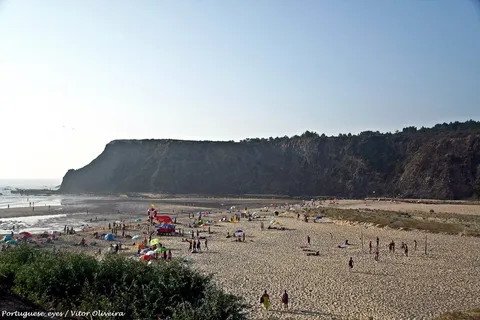
| Praia de Odeceixe | West (border) | River on one side, ocean on other | ~64°F (18°C) | Village lot, shuttle in summer |
| Ilha Deserta | East (Faro) | Genuine emptiness | ~73°F (23°C) | Ferry from Faro only |
| Ilha da Culatra | East (Olhão) | Fishing village plus beach | ~73°F (23°C) | Ferry from Olhão |
| Praia da Ilha de Tavira | East (Tavira) | Warm shallow water, families | ~73°F (23°C) | Ferry or footbridge at Santa Luzia |
| Praia de Cacela Velha | East (V.R.S.A.) | Lagoon swimming, quiet | ~73°F (23°C) | Walk down from village, wade at low tide |
| Praia da Marinês / Três Irmãos | Central (Alvor) | Rock arches without the Marinha queue | ~72°F (22°C) | Alvor lots, short walk |
The central Algarve: cliffs, coves and company
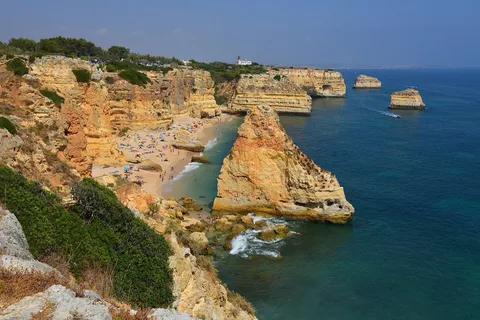
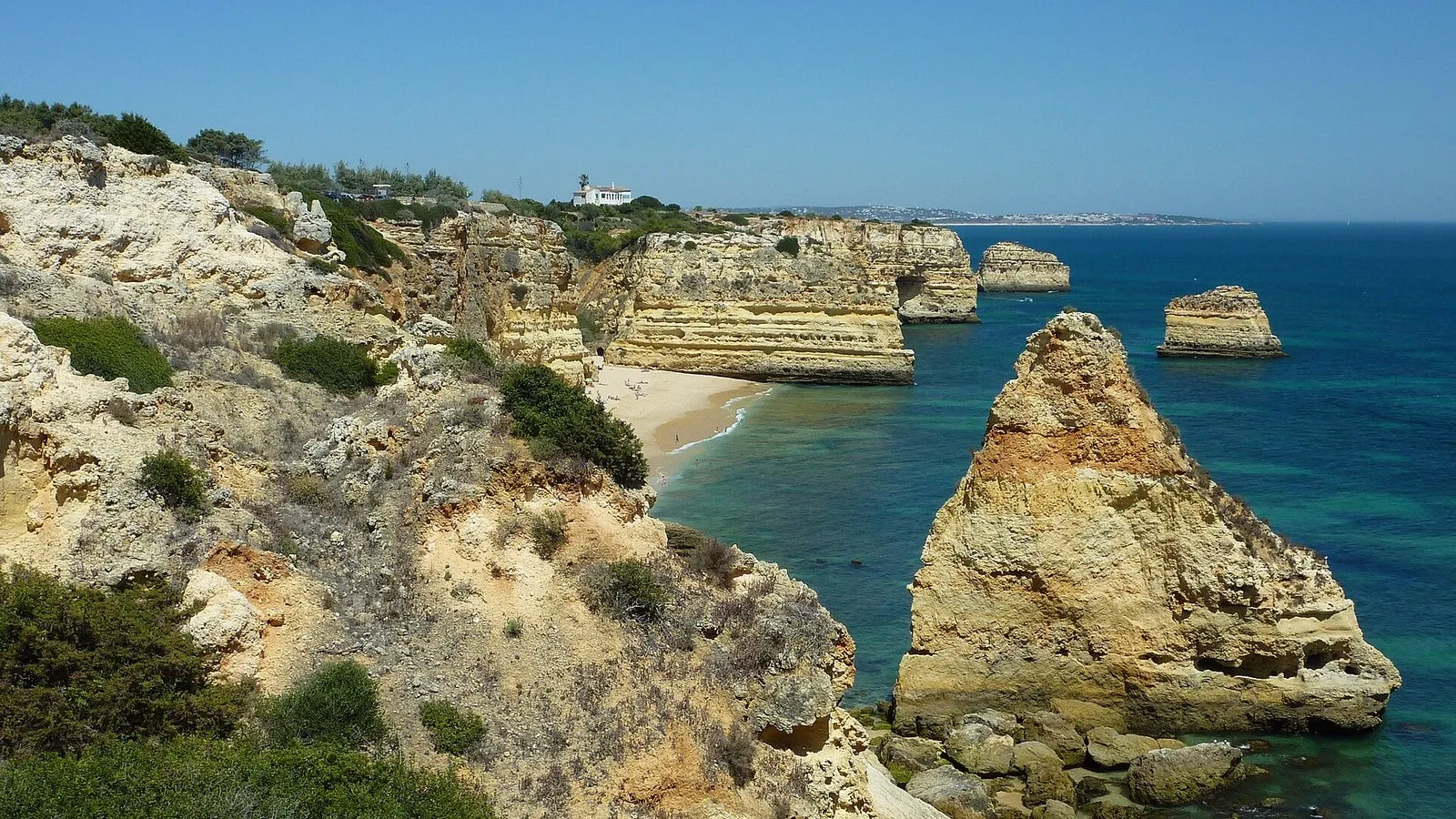
This is the stretch between Lagos and Albufeira, and it is what sells the Algarve. Ochre sandstone cliffs, sea stacks, coves the size of a tennis court with turquoise water at the bottom. It is genuinely beautiful and it is genuinely packed from late June through early September.
Praia da Marinha is the famous one, the double arch you have seen on every Portugal travel poster. The beach itself is small and the descent is a proper staircase, so it is not a great choice with a stroller or dodgy knees. Go before 9am or after 5pm. The clifftop walk east toward Benagil is free, spectacular, and most people never do it.
Praia do Camilo near Lagos requires 224 wooden steps down and, more memorably, 224 back up. The reward is two connected coves and some of the clearest snorkelling water on this coast. Parking is limited to a small lot that fills by 10am in summer.
Praia Dona Ana is the compromise pick if you have kids: same cliff scenery, gentler access, a beach bar, and lifeguards. It was widened with imported sand after storm damage, which purists grumble about and families do not.
Praia da Falésia is the outlier here at four miles long, backed by striped red and white cliffs, with enough room that even August feels manageable if you walk five minutes from the access ramp. It is the one central beach where you can genuinely get away from people.
Benagil deserves a warning. The sea cave is real and it is stunning, but you can no longer swim into it unsupervised, and the beach itself is a small strip with a parking situation that turns ugly by mid-morning. Book a boat or kayak tour from Portimão, Armacão de Pêra or Benagil itself, expect to pay around $29 to $46 (~€25 to €40) per person, and treat the beach as a departure point rather than a destination.
If you are stringing these together, our Algarve road trip itinerary covers the driving order that avoids doubling back.
The western Algarve: wild, cold and worth it
Round the corner at Sagres and everything changes. The Costa Vicentina faces the open Atlantic, sits inside a protected natural park, and has almost no resort development because building is heavily restricted. The wind blows most afternoons. The water is cold enough to make you gasp.
That cold is not bad luck, it is oceanography. Summer northerly winds drive coastal upwelling that pulls deep water to the surface, which is why the west coast can sit eight to ten degrees Fahrenheit below the south-facing beaches on the same day. The Portuguese weather institute (IPMA) publishes daily sea surface temperatures if you want to check before committing.
Praia do Amado is the surf school beach: consistent beach break, several schools operating from the gravel lot, and a laid-back scene that skews young. Praia da Bordeira next door is enormous, backed by dunes and a river mouth, and even in August you can walk until nobody is near you.
Praia da Arrifana sits in a horseshoe bay under a headland with a ruined fort, and the sunsets there are the best on this coast. The road down is steep and narrow, and the small lot at the bottom fills fast. Praia de Odeceixe is the northern bookend, a river beach and an ocean beach in one, with calm water on the river side that suits small children.
If waves are the actual point of your trip rather than a bonus, we ranked the country’s breaks in our guide to the best surf beaches in Portugal.
The eastern Algarve: sandbar islands and lagoon water
East of Faro the cliffs stop and the Ria Formosa begins, a lagoon and barrier island system running about 37 miles to the Spanish border. The beaches out here are long, flat, sandy and reached by boat, which filters out most of the day-trip crowd automatically.
Ilha Deserta (officially Ilha da Barreta) has one restaurant and nothing else. Ferries run from Faro’s marina and the crossing takes around 45 minutes. Ilha da Culatra has a working fishing community, no cars, and a beach on the ocean side that regularly has more shells than people.
Praia da Ilha de Tavira is the easiest to reach and the most family-friendly: warm shallow water, full facilities, and a short ferry from Tavira or a footbridge crossing at Santa Luzia. Cacela Velha is the connoisseur pick, a whitewashed village above a lagoon you wade across at low tide.
The lagoon is a protected natural park managed by the Portuguese environment agency (APA), which also publishes bathing water quality data for every classified beach in the country. Every beach in this guide holds good or excellent status, but the data is public if you want to check a specific spot.
How cold is the Algarve water, really?
Warmer than the rest of Portugal and colder than the Mediterranean. Americans arriving from Florida or Southern California will find it brisk. Anyone from the Northeast will find it fine.
| Month | South coast sea | West coast sea | Air high | Swimmable? |
|---|---|---|---|---|
| April | ~63°F (17°C) | ~59°F (15°C) | ~68°F (20°C) | Brief dips |
| May | ~64°F (18°C) | ~61°F (16°C) | ~73°F (23°C) | Yes, if hardy |
| June | ~68°F (20°C) | ~63°F (17°C) | ~79°F (26°C) | Yes |
| July | ~70°F (21°C) | ~63°F (17°C) | ~84°F (29°C) | Yes |
| August | ~72°F (22°C) | ~64°F (18°C) | ~84°F (29°C) | Warmest of the year |
| September | ~72°F (22°C) | ~64°F (18°C) | ~81°F (27°C) | Yes, best month overall |
| October | ~68°F (20°C) | ~63°F (17°C) | ~75°F (24°C) | Yes, quiet |
| November | ~64°F (18°C) | ~61°F (16°C) | ~68°F (20°C) | Marginal |
These are approximate multi-year averages and any given week can run warmer or cooler. The pattern holds though: the south coast peaks in late August and stays warm through September, and the west coast barely moves all summer. For a wider seasonal view, see our breakdown of Portugal in October.
One safety note that matters more than the temperature. Lifeguarded bathing seasons are set annually by the Autoridade Marítima Nacional (AMN), and outside those dates there is no supervision at all. The flag system is legally enforced: green means swim, yellow means wade only, red means stay out of the water, and checkered means the lifeguard is off duty. The west coast has strong rip currents and people drown there every year.
What does an Algarve beach day cost?
Less than you would pay on the Spanish costas or in southern France, and a lot less than a comparable day in California. The Algarve is Portugal’s dominant tourism region, and the national statistics office (INE) consistently reports it near the top for overnight stays, which means competition keeps prices honest outside the peak fortnight.
| Item | Typical cost | Notes |
|---|---|---|
| Beach parking | Free to $6 (~€5) | Most lots are free; Lagos and Albufeira charge in summer |
| Two sunbeds plus umbrella | $17–$29 (~€15–€25) | Per day, central Algarve; often free at west coast beaches |
| Lunch at a beach restaurant | $17–$29 (~€15–€25) | Per person, grilled fish and wine |
| Ferry to a Ria Formosa island | $6–$14 (~€5–€12) | Round trip, per person |
| Benagil cave boat tour | $29–$46 (~€25–€40) | Per person, 1 to 2 hours |
| Surf lesson with board and wetsuit | $41–$58 (~€35–€50) | Group lesson, west coast |
| Rental car | $41–$70 (~€35–€60) per day | Higher in August; book months ahead |
You will want a car. Buses connect the main towns along the N125 and the train runs Lagos to Vila Real de Santo António, but almost none of the good beaches are walkable from a station. Book the car early, because August rates in Faro roughly double when supply runs short. For how beach costs fit into a longer stay, our cost of living guide has the wider picture.
When should you go, and how do you dodge the crowds?
September. It is not a close call. The sea is at its warmest, the air has come off its July and August peak, Portuguese school holidays are over, and prices drop noticeably after the first week. May and early June are the other sweet spot if you can accept slightly cooler water.
August is the month to avoid if you have any flexibility. Portuguese, Spanish and northern European holidays all overlap, the coastal roads back up, and popular coves reach capacity before lunch.
Three tactics that actually work regardless of month. First, go early: most beaches are close to empty before 10am and the light is better anyway. Second, walk. Access points concentrate people within about 200 yards, so a ten-minute walk along the sand routinely gets you a third of the crowd density. Third, pick the neighbour. Praia da Marinha is full while Praia da Marinês and Praia dos Três Irmãos nearby are not, and they have the same rock formations.
Worth knowing before you go: several Algarve beaches have long-established clothing-optional sections, and the rules are not always signposted. We covered where those are and the etiquette involved in our guide to naturist beaches in Portugal.
If the Algarve is one leg of a longer trip, our two-week Portugal itinerary slots this coast into a north-to-south route, and the 2026 Portugal travel guide ranks the regions against each other.
The honest shortlist
If you have three beach days, spend one on the central cliffs (Marinha in the morning, then a Benagil boat), one on a Ria Formosa island out of Tavira or Olhão, and one on the west coast at Bordeira or Arrifana even if you only paddle. That gives you all three Algarves rather than three versions of the same one.
And if you are coming from the north of the country, the water up there is considerably colder but the beaches are wider and emptier, which we get into in our roundup of the best beaches near Porto. Different coast, different trip, same country. Wherever you land on this list, the best beaches in the Algarve reward an early alarm more than a big budget.
Frequently asked questions
What is the single best beach in the Algarve?
For scenery, Praia da Marinha. For a full day with facilities and space, Praia da Falésia. For warm shallow water with kids, Praia da Ilha de Tavira. There is no universal answer because the three Algarve coastlines serve completely different trips, and the cliff beaches that photograph best are also the smallest and most crowded.
Can you still swim into the Benagil cave?
Not on your own. Unsupervised swimming and independent access into the cave were restricted after repeated rescues, and entry now runs through licensed boat, kayak and SUP operators. Tours cost roughly $29 to $46 (~€25 to €40) per person and run from Benagil, Armacão de Pêra and Portimão. Morning departures have calmer water and better light inside the cave.
Is the Algarve water warm enough to swim in?
On the south coast, yes: around 72°F (22°C) in August and September, comparable to the mid-Atlantic US coast in summer. The west coast between Sagres and Odeceixe runs roughly 64°F (18°C) year-round because of coastal upwelling, which most people find bracing without a wetsuit.
Do I need a car to reach Algarve beaches?
Practically, yes. Trains and buses serve the towns along the coast, but the best beaches sit at the end of side roads with no public transport. A rental runs about $41 to $70 (~€35 to €60) a day and should be booked months ahead for July and August, when Faro airport supply tightens and rates climb sharply.
Which Algarve beaches are least crowded in summer?
The west coast beaches (Bordeira, Amado, Odeceixe) and the Ria Formosa barrier islands (Ilha Deserta, Culatra) stay comparatively empty even in August, the first because of wind and cold water, the second because reaching them requires a ferry. On the central coast, Praia da Falésia absorbs crowds better than anywhere else simply because it is four miles long.
Sources
This guide cites the following official sources. We link directly so you can verify every claim yourself.
Some links on this page are affiliate links. If you buy through them, we may earn a commission at no extra cost to you. How we research and update our guides