




On this page10 sections
- Is there a French lycée near you? The short answer
- What “AEFE-accredited” actually means — and why it isn’t binary
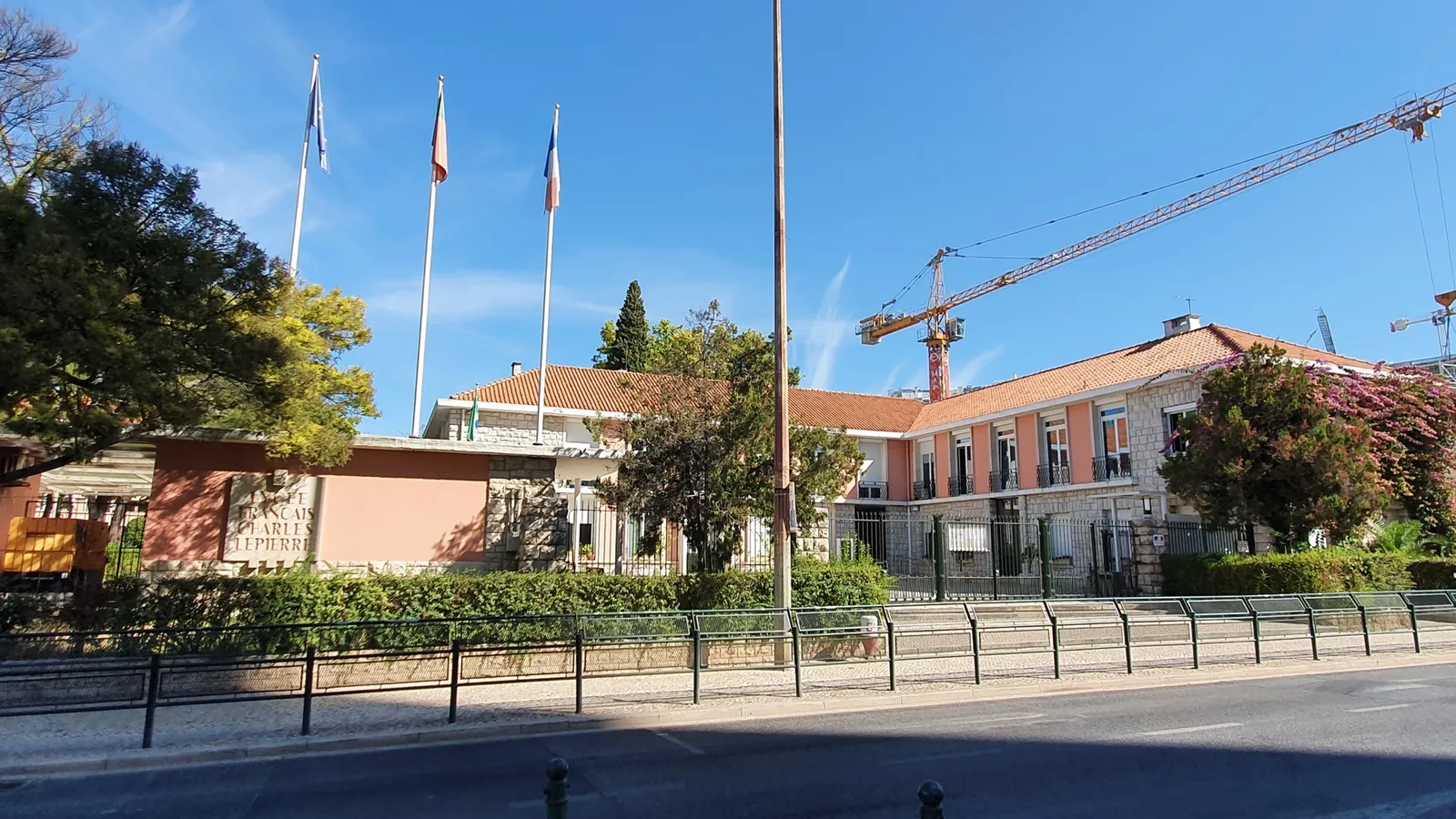
- Lycée Français Charles Lepierre, Lisbon: the largest, most established option
- Lycée Français International de Porto (LFIP): the northern option
- Redbridge School, Lisbon: AEFE-accredited, but not (yet) all the way through
- No AEFE lycée in the Algarve: what French, Belgian and Swiss families actually do
- CNED, explained: réglementée vs. libre, and the lighter “SCI” option
- The three tracks, side by side
- How and when to apply
- The bottom line
Key Takeaways: Portugal’s AEFE network has four homologated schools, all clustered in Lisbon and Porto: two full lycées running the complete French cursus through the Baccalauréat (Lycée Charles Lepierre in Lisbon, LFIP in Porto), plus two smaller Lisbon partner schools — Redbridge, whose French track currently only reaches Seconde, and L’École trilingue, a nursery-only option for ages roughly 3-6. None is in the Algarve. Full AEFE tuition at the two lycées runs roughly €5,400-€7,600 a year before a four-figure first-enrollment fee, well below the fees at English-curriculum international schools. Families outside the Lisbon-Porto axis fall back on Portuguese public or private school, an international school, or CNED distance learning.
Is there a French lycée near you? The short answer
If you’re moving to Lisbon or Porto with school-age kids, yes: both cities have a full AEFE lycée running maternelle through Terminale, with the French Baccalauréat at the end. If you’re moving anywhere else, including the Algarve, Braga, Coimbra or the interior, the answer is no, and no serious new AEFE opening is currently in the pipeline for those regions.
That single fact drives most of the practical questions French, Belgian and Swiss families ask: whether to base the whole relocation around a school postcode, whether Portuguese public school is really viable for a francophone teenager, and whether CNED can bridge the gap. This guide answers all three, with verified 2026 fees so you can budget before you commit to a neighborhood.
What “AEFE-accredited” actually means — and why it isn’t binary
AEFE (Agence pour l’Enseignement Français à l’Étranger) is the French state agency that runs and supervises France’s network of schools abroad. A school teaching a French program isn’t automatically an “AEFE school”: the French Ministry of National Education has to homologate its curriculum level by level, and AEFE then assigns the school one of three statuses, each with different obligations and different funding:
| Status | What it means | Portugal example |
|---|---|---|
| EGD (établissement en gestion directe) | Run directly by AEFE as a public establishment; the heaviest oversight and support | Lycée Français Charles Lepierre, Lisbon |
| Conventionné | Independently managed but under a formal agreement with AEFE | Lycée Français International de Porto (LFIP) |
| Partenaire | A lighter partnership; AEFE recognizes the homologation without the same funding ties | Redbridge School and L’École trilingue, Lisbon |
As of 2026, AEFE’s own établissement directory lists four schools for Portugal, and no others: the two lycées above, Redbridge, and a fourth, smaller Lisbon partner school, L’École trilingue. Its homologation covers only the nursery years — petite section through grande section, roughly ages 3-6 — for 44 students, so it isn’t a K-12 alternative to the three schools above. Some older guides still miss it, and also miss the newer, partial addition at Redbridge, whose AEFE recognition is recent and doesn’t (yet) cover the full cursus.
Homologation status matters practically because it determines whether your child’s school record is recognized automatically back in France (or another EU country), whether they can sit the brevet or baccalauréat as a school candidate rather than an independent one, and whether AEFE scholarships (for French nationals) apply.
Lycée Français Charles Lepierre, Lisbon: the largest, most established option
Founded in the 1950s, Lycée Charles Lepierre is one of AEFE’s EGD schools — the network’s most directly state-run category — and teaches more than 2,000 students from maternelle through Terminale in Lisbon. As the flagship EGD, it carries the deepest institutional backing of Portugal’s AEFE schools, but also the most exposure to AEFE’s own budget decisions (more on that below).
2026-2027 annual tuition, per the school’s published tariff schedule:
| Level | French / Portuguese / EU citizens | Other nationalities |
|---|---|---|
| Maternelle & élémentaire (PS-CM2) | €6,098 | €6,776 |
| Collège (6ème-3ème) | €6,384 | €7,062 |
| Lycée (2nde-Terminale) | €7,609 | €8,286 |
On top of tuition: a €2,500 first-enrollment fee for a first child, reduced by €700 (to €1,800) from the second child onward. Tuition itself drops 10% for a second child, 20% for a third, and 30% for a fourth or later. Confirm the current schedule directly on lfcl.pt’s tariffs page before budgeting, since these figures are revised annually.
One thing worth knowing before you commit: because Charles Lepierre is an EGD school administered directly by AEFE (see the status table above), its budget — and by extension its tuition — is also exposed to AEFE’s own state-funding decisions in a way LFIP’s conventionné model in Porto isn’t. Treat this year’s tariff as a starting point for planning rather than a number fixed for years ahead, and confirm directly with the school before committing to a multi-year budget.
Lycée Français International de Porto (LFIP): the northern option
LFIP is Porto’s conventionné AEFE school, founded in 1963 and now teaching roughly 1,300 students across the full maternelle-to-Terminale cursus. For families settling in Porto rather than Lisbon, it’s the only full AEFE option in the north.
2026-2027 annual tuition, per the school’s published fee page:
| Level | Annual tuition |
|---|---|
| Maternelle | €5,683 |
| Primaire | €5,389 |
| Collège | €6,027 |
| Lycée | €6,615 |
Enrollment fees run separately: a €1,030 first-enrollment fee, and for the 2026-2027 re-registration campaign, €550 if paid by 28 February 2026 or €650 between 1 March and 30 April 2026. Both the first-enrollment and re-registration fees cover school materials and student insurance. Confirm the exact current figures on LFIP’s registration page before applying, since these figures are revised annually.
Redbridge School, Lisbon: AEFE-accredited, but not (yet) all the way through
Redbridge is a newer, trilingual French/English/Portuguese school in Lisbon that has drawn attention for a genuine reason: it holds French Ministry of Education accreditation “dans le cadre du réseau de l’AEFE” (within the AEFE network framework), confirmed on both Redbridge’s own accreditation page and AEFE’s établissement listing, which shows it as a “partenaire” school with 338 students.
The caveat that matters: Redbridge’s French-track homologation currently covers 13 levels, from petite section through seconde — it has not (yet) been extended through première and terminale, so there’s no French Baccalauréat cohort there yet. The school also runs Portuguese-curriculum (DGEstE-accredited) and Cambridge-International streams in parallel, and is a candidate school for the IB Diploma rather than a fully authorized one. That combination can suit a family that hasn’t decided on a long-term curriculum, or wants French kept alive without the older-lycée intensity — but if you have a teenager heading toward the Bac in a few years, confirm directly with the school whether the upper levels have been added since this was verified, rather than assuming continuity.
No AEFE lycée in the Algarve: what French, Belgian and Swiss families actually do
This is the gap families searching for a French school in the Algarve, Braga, Coimbra or elsewhere outside Lisbon and Porto keep running into, and there’s no way around it honestly: none of the network schools above is anywhere near those regions, and nothing in AEFE’s current établissement list suggests that’s about to change. Three realistic paths cover it:
- Portuguese public school. Free and compulsory for residents from age 6 to 18 under Decreto-Lei n.º 176/2012, which regulates enrollment within that age range, regardless of nationality, provided your residency is in order. Instruction is entirely in Portuguese, with Português Língua Não Materna support for non-native speakers; younger children generally adapt faster than teenagers. We cover the enrollment mechanics in full in our guide to schools in Portugal for expats.
- An English-curriculum international school. The Algarve has a genuine cluster of IB and British-curriculum schools, just none teaching a French program. Our international schools in Portugal guide lists the Algarve options with 2026 fees, if English-language continuity matters more than French-language continuity for your family.
- CNED distance learning, either as the full curriculum or as a supplement to one of the above (see next section).
Whichever route you pick, plan the school decision alongside where you’ll actually live: neighborhood choice in Lisbon or a move to the Algarve changes which of these three paths is realistic, and it’s worth locking in before you commit to a lease. See our guide to renting an apartment in Portugal for the sequencing.
CNED, explained: réglementée vs. libre, and the lighter “SCI” option
CNED (Centre National d’Enseignement à Distance) is the French state’s own distance-learning provider, and it runs three distinct products relevant here, per CNED’s official guidance for families abroad:
- Classe complète, inscription réglementée: replaces local schooling entirely with the full French program. It requires a favorable opinion from the cultural advisor at the French embassy in Portugal beforehand, but in exchange gives access to official certificats de scolarité, relevés de notes, an orientation opinion, and the right to sit the brevet and baccalauréat as a school candidate rather than an independent one (plus scholarship eligibility for French nationals). For compulsory-school-age children (6-16) with that favorable opinion, this enrollment is free.
- Classe complète, inscription libre: also the full program, but with no age limit, no curriculum condition and no embassy approval needed. It’s a lighter service: students get a relevé de notes and an attestation de suivi on request, and sit the brevet or Bac as independent candidates.
- Scolarité Complémentaire Internationale (SCI): not a replacement, but a supplement for kids already attending a Portuguese or international school. It covers three core subjects per level (broadly French, math, and history-geography or civics, varying by grade) from grande section through terminale générale, so a child can keep their French-curriculum footing without leaving their local school. Most Portugal-based families outside Lisbon and Porto use this option rather than full-time CNED.
For enrollment or the embassy’s cultural-advisor sign-off, the French embassy’s Portugal page points families to the Institut français du Portugal at [email protected]. Exact current CNED tariffs for the “libre” track and for post-16 levels are published on cned.fr and change yearly, so confirm the number that applies to your child’s level before budgeting.
The three tracks, side by side
| Full AEFE lycée | Portuguese public school | CNED (full-time) | |
|---|---|---|---|
| Cost | ~€5,400-€7,600/yr + enrollment fee | Free (tuition) | Free if réglementée + eligible; libre track has its own published fee |
| Language of instruction | French | Portuguese | French, at home |
| Where available | Lisbon, Porto only | Everywhere | Everywhere, no location constraint |
| Curriculum continuity with France | Full, automatic | None | Full, but needs the embassy step for official recognition |
| Best fit | Families settled in Lisbon/Porto wanting a seamless French track | Families anywhere, comfortable with a Portuguese-language classroom | Families outside Lisbon/Porto who need the French program specifically, or short-term postings |
How and when to apply
Apply well before the school year you’re targeting, especially for Lisbon and Porto, where AEFE lycées are the default choice for a large, established French community and popular year groups can fill early. LFIP’s own 2026-2027 re-registration deadlines (28 February for the lower fee, 30 April for the higher one) are a useful proxy for how far ahead these schools plan; new-family applications should go in well before that window closes. For CNED réglementée, start the embassy cultural-advisor approval process early too, since it’s a prerequisite, not a formality processed on the same day.
Whichever school you’re applying to, expect to provide prior school records, identity documents, and — depending on the family’s origin — apostilled or translated paperwork. If your child is transferring from the Portuguese system into an AEFE lycée or vice versa, ask the receiving school directly how it handles grade-level placement; there’s no single automatic equivalency table covering every case.
The bottom line
Portugal’s French-school landscape in 2026 is smaller and more specific than a quick search suggests: two full AEFE lycées, both in Lisbon and Porto, plus two smaller Lisbon partner schools — Redbridge (through Seconde) and the nursery-only École trilingue — neither a full substitute for a lycée through the Bac, and genuinely nothing in the Algarve or anywhere else. If a French lycée is non-negotiable for your family, that fact should shape where you live, not follow from it. If it isn’t, Portuguese public school, an English-curriculum international school, or CNED — full-time or as a supplement — all give a workable, and in most cases free or low-cost, path to keeping your child’s education on track while you settle in.
Frequently asked questions
Is there a French lycée in the Algarve?
No. As of 2026, AEFE's own établissements directory lists four French-network schools in Portugal, all in the Lisbon-Porto axis: Lycée Charles Lepierre, Redbridge School and the nursery-only École trilingue, all in Lisbon, plus LFIP in Porto. Families in the Algarve rely on Portuguese public or private school, an English-curriculum international school, or CNED distance learning to keep a French track going.
What does "AEFE-accredited" actually mean?
It means the French Ministry of National Education has homologated the school's curriculum, and AEFE (the agency that runs France's overseas school network) has given it one of three statuses. Lycée Charles Lepierre is an EGD (state-run directly by AEFE), LFIP is "conventionné" (an agreement with AEFE), and Redbridge is a "partenaire" school with a lighter tie. All three follow French programs, but the status affects support, fees and oversight.
How much does the Lycée Français Charles Lepierre in Lisbon cost?
For 2026-2027, French, Portuguese and other EU citizens pay €6,098/yr in maternelle and élémentaire, €6,384/yr in collège, and €7,609/yr in lycée; other nationalities pay somewhat more at each level. On top of that there's a €2,500 first-enrollment fee (€1,800 from a second child), before sibling discounts of 10-30% on tuition itself.
Can I use CNED instead of enrolling in a physical school?
Yes, in two ways. "Inscription réglementée" needs a favorable opinion from the French embassy's cultural advisor first, but is free for compulsory-school-age children (6-16) and lets them sit the brevet or baccalauréat as school candidates. "Inscription libre" needs no approval and no age limit, but is a lighter service and they'd sit exams as independent candidates. Most Portugal-based families use CNED's smaller Scolarité Complémentaire Internationale alongside a local school instead of full-time CNED.
Is Redbridge in Lisbon the same as the two AEFE lycées?
Not quite. Redbridge is genuinely AEFE-accredited for its French track, but as of 2026 that homologation only runs from petite section through seconde (roughly age 3 to 15) — it hasn't been extended through terminale and the French baccalauréat yet. Families with older teens should confirm current levels directly with the school before assuming it covers the full cursus.
Do French, Belgian or Swiss families need a visa to enrol a child in a Portuguese school?
No student visa is required. French and Belgian citizens have EU free-movement rights, and Switzerland's nationals get equivalent residence rights under its bilateral agreement with the EU. Anyone staying over three months registers for the Certificado de Registo de Cidadão da União Europeia (CRUE) at their local Câmara Municipal, per AIMA — a separate step from school enrollment itself.
Sources
This guide cites the following official sources. We link directly so you can verify every claim yourself.
- Aefeaefe.gouv.fr
- Aefeaefe.gouv.fr
- Aefeaefe.gouv.fr
- Aefeaefe.gouv.fr
- Lfcllfcl.pt
- Lfiplfip.pt
- PTpt.diplomatie.gouv.fr
- Cnedcned.fr
- Redbridgeschoolredbridgeschool.com
- Diário da Repúblicadiariodarepublica.pt
- AIMA — Agência para a Integração, Migrações e Asiloaima.gov.pt
Some links on this page are affiliate links. If you buy through them, we may earn a commission at no extra cost to you. How we research and update our guides