





On this page10 sections
- What does renting an apartment in Portugal actually cost in 2026?
- What documents will a Portuguese landlord ask an American for?
- Where do you actually find long-term listings?
- How do you read a contrato de arrendamento?
- Why must you insist the lease is registered with Finanças?
- What does “sem despesas” hide in the utility bill?
- What are the common rental scams and traps?
- Final Thoughts
Key Takeaways: Long-term rents in Portugal run roughly $754 (€650) a month for a one-bedroom in Braga to about $1,508 (€1,300) in Lisbon. Landlords don’t care about your US credit score; they want a Portuguese NIF, a local IBAN, and proof of income. Since 2023 the deposit is legally capped at two months, so nobody can demand a year up front. Insist on a registered lease.
What does renting an apartment in Portugal actually cost in 2026?
Budget roughly $750 to $2,200 (~€650 to ~€1,900) a month, depending on the city and whether you need one bedroom or two. Asking rents in July 2026 worked out to €23.5 per square metre in Lisbon, €18.1 in Porto, €14.9 in Faro, €14.2 in Setúbal, €14.0 in Coimbra, €13.6 in Aveiro, and €10.8 in Braga, according to idealista’s monthly rental report. Braga is the cheapest of the major university cities, below both Coimbra and Aveiro.
| City | 1-bed (T1) / month | 2-bed (T2) / month |
|---|---|---|
| Lisbon | $1,508 (~€1,300) | $2,204 (~€1,900) |
| Porto | $1,218 (~€1,050) | $1,682 (~€1,450) |
| Faro (city) | $1,044 (~€900) | $1,450 (~€1,250) |
| Setúbal | $986 (~€850) | $1,334 (~€1,150) |
| Coimbra | $986 (~€850) | $1,334 (~€1,150) |
| Aveiro | $928 (~€800) | $1,276 (~€1,100) |
| Braga | $754 (~€650) | $1,044 (~€900) |
Two caveats matter more than the numbers themselves. First, those are asking prices. Rents on leases actually signed run well below listings: Statistics Portugal (INE) put the national median for new contracts at €9.46 per square metre in the first quarter of 2026, with Lisbon municipality at €17.22 and Porto at €14.29. There’s negotiating room in that gap.
Second, “the Algarve” is not one market. Faro city is mid-priced, but the Algarve as a region hit €22.5 per square metre in July 2026, up 34.3% in a year, which makes it the most expensive rental region in the country, ahead of greater Lisbon. Budget Vilamoura, Almancil, or Albufeira at close to Lisbon prices, not Faro prices.
One thing Americans get wrong: the advertised rent is close to the real rent. There’s no amenity fee, no mandatory renter’s insurance bundle, no pet rent in most cases. What you add is utilities, and sometimes condomínio. For the wider picture, our cost of living breakdown for expats puts rent alongside groceries, transport, and health cover, and the city-level detail sits in the Lisbon and Porto guides.
What documents will a Portuguese landlord ask an American for?
Five things, almost always: a NIF, a Portuguese bank IBAN, proof of income, a copy of your passport, and ideally a fiador (guarantor). Your US credit report means nothing here. Nobody will pull it, nobody can read it, and offering it signals you don’t understand the system.
The NIF is the tax number, and it comes first because you can’t sign a registered lease without one. Get it before you start viewing apartments, not after. Our walkthrough on getting a NIF in Portugal covers the remote-representative route most Americans use. As a non-EU citizen without residence here, you’ll also need either a fiscal representative or enrolment in electronic tax notifications.
The fiador problem, and what the law now allows
A fiador is a Portuguese resident who co-signs and becomes liable for your rent. Newly arrived Americans don’t have one. The old workaround was to throw money at the problem, six or twelve months up front, and plenty of blog posts still tell you to do exactly that. That advice is out of date.
Since 1 January 2023, article 1076.º of the Civil Code, as amended by Lei n.º 24-D/2022, caps the security deposit at two months’ rent, with advance rent separately capped at two months. The most anyone should be collecting at signing is around four months plus the current month. A landlord demanding a year up front is operating outside the law, and some genuinely haven’t caught up rather than trying it on.
That cap is still the law as of September 2026, but don’t assume it stays that way. On 9 July 2026 the Council of Ministers approved a rental-law reform bill that would scrap the deposit ceiling entirely and let landlords ask for up to three months’ rent in advance instead of two. It was still working through parliament and hadn’t become law when this was last checked, so the two-month cap applied. If you’re reading this later in 2026, confirm the bill’s status before you assume either number.
What that leaves you is a paper case. Bring the last three months of bank statements, a remote-work contract or client invoices, and, if you’re on a D7 or D8 visa, the same income documentation you filed with the consulate. Pension letters and Social Security award letters land well because they read as stable. Print everything. Portuguese agencies still love paper.
Why you need the bank account first
Rent gets paid by transferência or direct debit from a Portuguese IBAN. Landlords dislike foreign transfers, partly for the fees and partly because a local IBAN signals you’re actually staying. Sort it early. The steps are in our guide to opening a Portuguese bank account, and it slots into the wider sequence in moving to Portugal from the USA.
Where do you actually find long-term listings?
Start with Idealista, Imovirtual, and Casa Sapo, then accept that the best apartments never reach them. Idealista is the largest portal and also publishes municipal price data worth reading before you negotiate anything.
Here’s the part people learn too late. A landlord with a good, fairly priced flat in Braga or Coimbra shows it to three neighbours and a cousin before paying for a portal listing. Local imobiliárias get the next tier. Portals get what’s left, plus a fair amount of overpriced stock aimed at foreigners.
So work three channels at once. Walk the neighbourhoods you actually want and photograph the arrenda-se signs taped in windows, because a surprising number are never digitised. Join the city-specific Facebook groups, but treat them as lead generation and never as a payment channel. And walk into two or three imobiliárias in person with your documents in a folder. Showing up prepared moves you up the list faster than any email.
If you’re targeting the capital, pick the neighbourhood before the apartment. Rents swing sharply across a twenty-minute metro ride, and our rundown of the best Lisbon neighbourhoods for expats maps that out. Plenty of Americans also rent for a year and buy afterwards, which is sensible; the process and tax differences are covered in our guide to buying property in Portugal as a foreigner.
How do you read a contrato de arrendamento?
Six clauses decide whether the lease actually protects you: duration and renewal, notice periods, the annual rent increase, who pays what, the deposit terms, and the inventory. Residential leases are governed by the Novo Regime do Arrendamento Urbano, approved by Lei n.º 6/2006 and amended many times since, most recently by the Mais Habitação package. One thing worth knowing: the rules you actually care about, on lease length and notice, sit in the Civil Code, articles 1094.º to 1101.º, which the NRAU amended. Anyone quoting notice periods “under Lei 6/2006” is citing the wrong statute.
Duration and renewal. A habitation lease must run for at least one year. Unless your contract says otherwise, it renews automatically for three-year periods.
Notice periods. You’re not locked in for the whole term. Once one third of the initial period, or of the current renewal, has passed, you can leave at any time by giving 120 days’ written notice, or 60 days if the term is under a year. To simply stop a renewal, notice runs from 60 to 120 days depending on contract length. On a standard one-year lease that means you’re committed for about four months, then need four months’ notice.
The annual rent increase. Increases are capped by a coefficient published each autumn. For 2026 it’s 1.0224, a maximum rise of 2.24% (Aviso n.º 23174/2025/2, Diário da República 2.ª série, 19 September 2025). For 2025 it was 1.0216. Unlike 2023, when the government overrode the formula with a 2% cap, there’s no special cap this year, so the full coefficient applies. Your landlord must notify you in writing at least 30 days before it takes effect, stating the coefficient and the new rent. No notice, no increase.
Who pays what. IMI, the annual municipal property tax, is levied on whoever owns the property on 31 December, so it’s always the landlord’s. You should never be asked for it. Condomínio defaults to the landlord under article 1078.º of the Civil Code, but a lease can lawfully shift ordinary charges to you, so read that clause twice.
Deposit terms. Portugal has no deposit protection or escrow scheme. Unlike the UK, your money sits in the landlord’s account with no third party holding it. Make sure the contract states the amount, the conditions for return, and the timeline.
Inventory and condition. Attach a dated photo inventory as an annex, signed by both parties. If there’s a dispute later, recovering a deposit means going to the Balcão Nacional do Arrendamento or the courts, and photographs are what win it. This is the cheapest insurance policy in the whole process.
Why must you insist the lease is registered with Finanças?
Because an unregistered lease leaves you with no rent receipts, no usable proof of address, and weak legal footing. Your landlord must declare the lease to the tax authority through the Portal das Finanças, using Modelo 2 of the stamp duty declaration, by the end of the month after the lease begins. They must also issue you an electronic recibo de renda each month through the same portal. A bank transfer alone doesn’t count.
Stamp duty of 10% of one month’s rent is due on the contract, and again on any increase. The landlord is the person legally liable for it. If one asks you to cover it, that’s a negotiation, not the law.
Some owners “forget” the whole process to keep the rental income invisible, and they’ll offer you a small discount to look the other way. Don’t take it. Without registration and monthly recibos you can’t claim the rent deduction on your Portuguese tax return, and AIMA won’t accept your address. An informal arrangement can quietly derail a residency renewal a year later.
Ask directly at the viewing: “O contrato vai ser registado nas Finanças?” A straight yes tells you a lot about everything else too. The Portal da Habitação is a reasonable starting point for tenant-facing rules and support programmes.
What does “sem despesas” hide in the utility bill?
Sem despesas means expenses aren’t included, and for a typical two-bedroom you should budget somewhere around $110 to $200 (~€95 to ~€172) a month on top of rent for electricity, water and rubbish combined. Electricity is the biggest line item, because most Portuguese apartments are heated electrically or not at all. ERSE, the energy regulator, prices a typical two-adult household on the regulated tariff at around €37 a month for 2026, but that’s a baseline for modest use, not a winter number. An old stone building with no insulation and electric heating running all day can triple it in January and February.
Water and rubbish usually land in the $23 to $46 (~€20 to ~€40) range. Gas, where the building has it, is modest. Internet is genuinely cheap by American standards, and the packages, speeds, and contract traps are compared in our guide to the best internet providers in Portugal.
Watch for contracts that keep utilities in the landlord’s name and bill you at a markup. Put the accounts in your own name where you can. Each one is also a proof-of-address document, which matters more than you’d expect.
What are the common rental scams and traps?
The wire-transfer scam is the main one, and it’s simple: a listing well below market, an owner conveniently abroad, and a request for a deposit before viewing. Never send money for a property you or someone you trust hasn’t physically stood inside. The Banco de Portugal publishes consumer warnings on payment fraud, and the pattern never changes.
Four quieter traps matter more, because they catch careful people.
“Furnished” is elastic. Mobilado can mean a full kitchen and beds, or a sofa and a lamp. Portuguese kitchens often lack ovens, and washing machines live in the bathroom. Photograph everything at the viewing and confirm in writing what stays.
Damp and mould. Buildings without insulation grow black mould on north-facing walls between November and March. View in winter if you can. If you can’t, check ceiling corners, behind wardrobes, and around window frames for fresh paint that’s suspiciously newer than the wall around it.
No central heating. Most Portuguese housing has none, and the data is blunt about the consequences: in 2024, 15.7% of people in Portugal could not keep their home adequately warm, against an EU average of 9.2%, according to Eurostat’s EU-SILC survey published via Pordata. That’s a real improvement on 20.8% in 2023, the steepest fall in the EU, but Portugal still sits among the worst in Western Europe. The cause is the building stock, not the weather. Ask what heating exists and what last winter’s electricity bill looked like.
Verbal side agreements. “Of course you can have a dog,” said cheerfully at a viewing, is worth nothing in March. If it isn’t in the contract or a signed annex, it doesn’t exist.
Final Thoughts
Renting an apartment in Portugal rewards preparation more than budget. Get the NIF, open the bank account, assemble a folder of income proof, and know the deposit cap before a landlord tests it on you. Then go and look at places in person, in the neighbourhoods you actually want, in the worst weather you can manage. If you’re wondering whether to keep renting long term, our renting vs buying in Portugal breakdown runs the five-year numbers for Lisbon, Porto and Braga.
And hold the line on registration. A properly registered contract with monthly recibos costs you nothing extra, and it’s the document that makes the rest of your Portuguese life work: residency, healthcare, tax status. The apartment with the slightly better view isn’t worth an informal handshake.
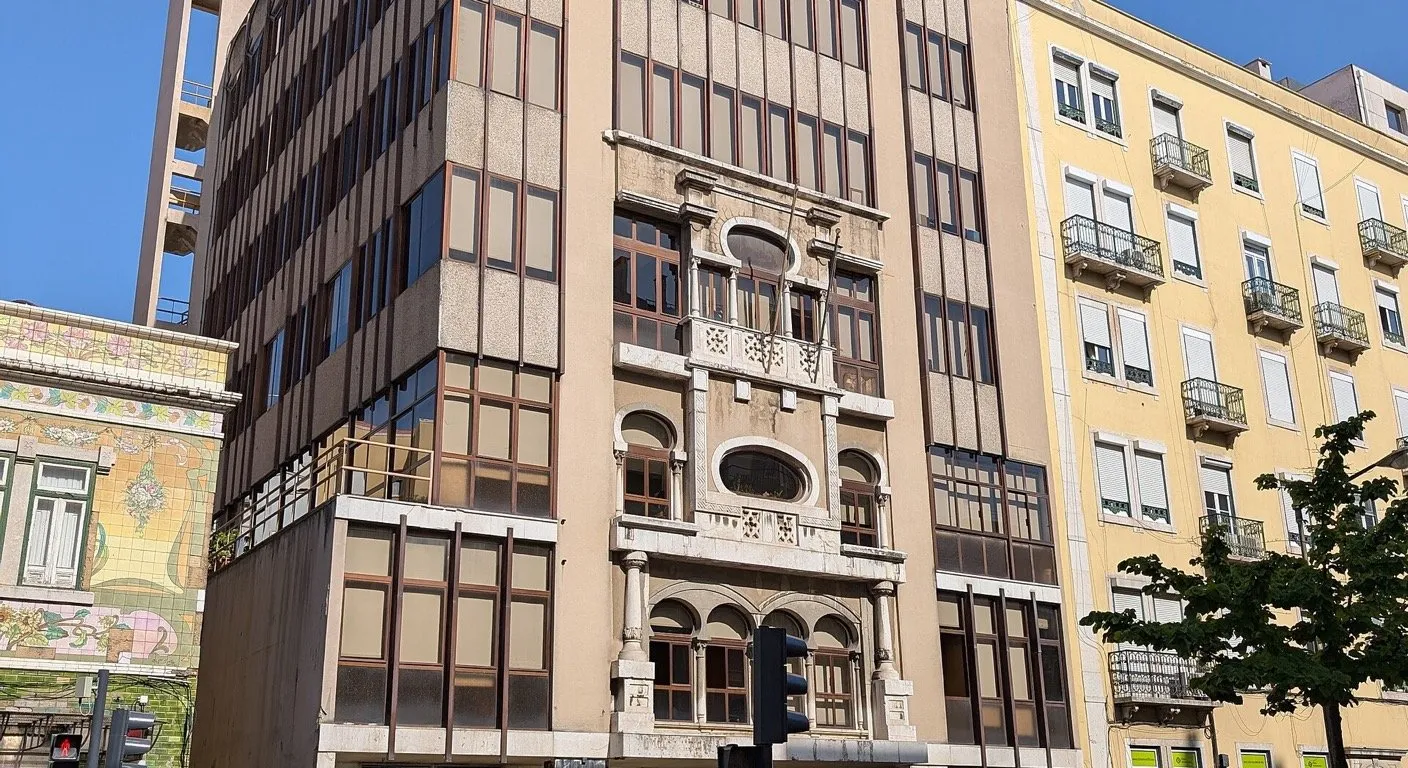
Featured image: apartment buildings on Avenida Almirante Reis, Lisbon. Photo by Philip Mallis, CC BY-SA 4.0, via Wikimedia Commons.
Frequently asked questions
How much does it cost to rent an apartment in Portugal?
Budget roughly $750 to $2,200 (~€650 to ~€1,900) a month for a one- or two-bedroom, depending on the city. Braga is the cheapest of the major cities at around $754 (~€650) for a one-bedroom; Lisbon is the most expensive at around $1,508 (~€1,300). Add $110 to $200 (~€95 to ~€172) for utilities on top, since Portuguese rents rarely bundle them in.
Can Americans rent an apartment in Portugal before getting a residence visa?
Yes. There’s no nationality or residency requirement to be a tenant. What you need is a NIF, proof you can pay, and realistically a Portuguese bank account. Many Americans sign a lease during a scouting trip and then use it as address proof at their AIMA appointment, so the lease often has to exist first.
What should a Portuguese rental agreement include?
A registered contrato de arrendamento should state the parties, the property, the monthly rent and payment method, the deposit and advance-rent amounts, the start date and duration, who pays which charges, and a dated photo inventory as a signed annex. Confirm your landlord will register it with Finanças and issue monthly electronic recibos; an unregistered lease weakens your legal position and won’t satisfy AIMA.
How many months of deposit can a landlord ask for in Portugal?
Two months is the current legal maximum for the security deposit, with advance rent capped at another two, for a realistic worst case of about five months’ rent at signing, roughly $4,930 to $7,540 (~€4,250 to ~€6,500) for a mid-range one-bedroom. A government bill to remove that cap entirely was before parliament as of September 2026 but hadn’t passed, so the two-month limit still stood. Many landlords still ask for less.
What is a normal monthly condomínio (building) fee in Portugal?
It varies enormously, and there’s no official national average, because condomínio is set building by building rather than regulated like rent. A block with no lift, pool or shared services costs far less than a newer building with an elevator, pool or doorman. Ask to see the last 12 months of condomínio minutes and payment records before signing; a cheaper rent with a high hidden condomínio isn’t actually a discount.
Do I pay the real estate agent’s fee?
Usually not. Under Lei n.º 15/2013, the mediation fee is owed by whoever signed the mediation contract with the agency, and for lettings that’s almost always the owner. Charging a tenant isn’t illegal, but it’s only lawful if you personally signed a mediation contract setting out the fee. Refuse an unsolicited “finder’s fee” at signing, and check the agency’s IMPIC licence number.
Sources
This guide cites the following official sources. We link directly so you can verify every claim yourself.
- Idealistaidealista.pt
- INE — Instituto Nacional de Estatísticaine.pt
- Diário da Repúblicadiariodarepublica.pt
- Portal das Finançasportaldasfinancas.gov.pt
- Portal da Habitaçãoportaldahabitacao.pt
- Banco de Portugalbportugal.pt
- PORDATApordata.pt
- Governo de Portugalportugal.gov.pt
- ERSEerse.pt
- AIMA — Agência para a Integração, Migrações e Asiloaima.gov.pt
Some links on this page are affiliate links. If you buy through them, we may earn a commission at no extra cost to you. How we research and update our guides