




On this page10 sections
- When are the Vigo Christmas lights switched on in 2026?
- How do you get from Porto to Vigo?
- What do the tolls cost on each side of the border?
- What is the time difference between Portugal and Spain?
- Where do you park in Vigo during the lights?
- How bad are the crowds on 1 and 8 December and on weekends?
- What else should you plan for a Vigo day trip?
Key Takeaways: Vigo is a day trip from Porto by car (about 1.5 hours), coach (about 2 hours) or the Celta train, which currently includes a road-bus leg. Spain is one hour ahead of Portugal. The 2026 switch-on date is not announced as of 3 November 2026, and weekends and the 1 and 8 December holidays are the busiest days.
Last checked: 3 November 2026.
When are the Vigo Christmas lights switched on in 2026?
The Concello de Vigo had not published a date as of 3 November 2026. The mayor has called it “the best kept secret”, according to El Debate. Local press has only floated guesses: El Español points to Friday 13 or Saturday 14 November, and Diario de Pontevedra mentions 14 November or the weekend of 20 and 21 November. Neither is confirmed. The official source is the Concello de Vigo Christmas page.
Past dates give a pattern, not a promise. The 2024 campaign started on Saturday 16 November, and local guides report Saturday 15 November for 2025. For 2026, no end date for the lights is announced either. Last year’s run reportedly lasted until 11 January 2026, per tourism listings.
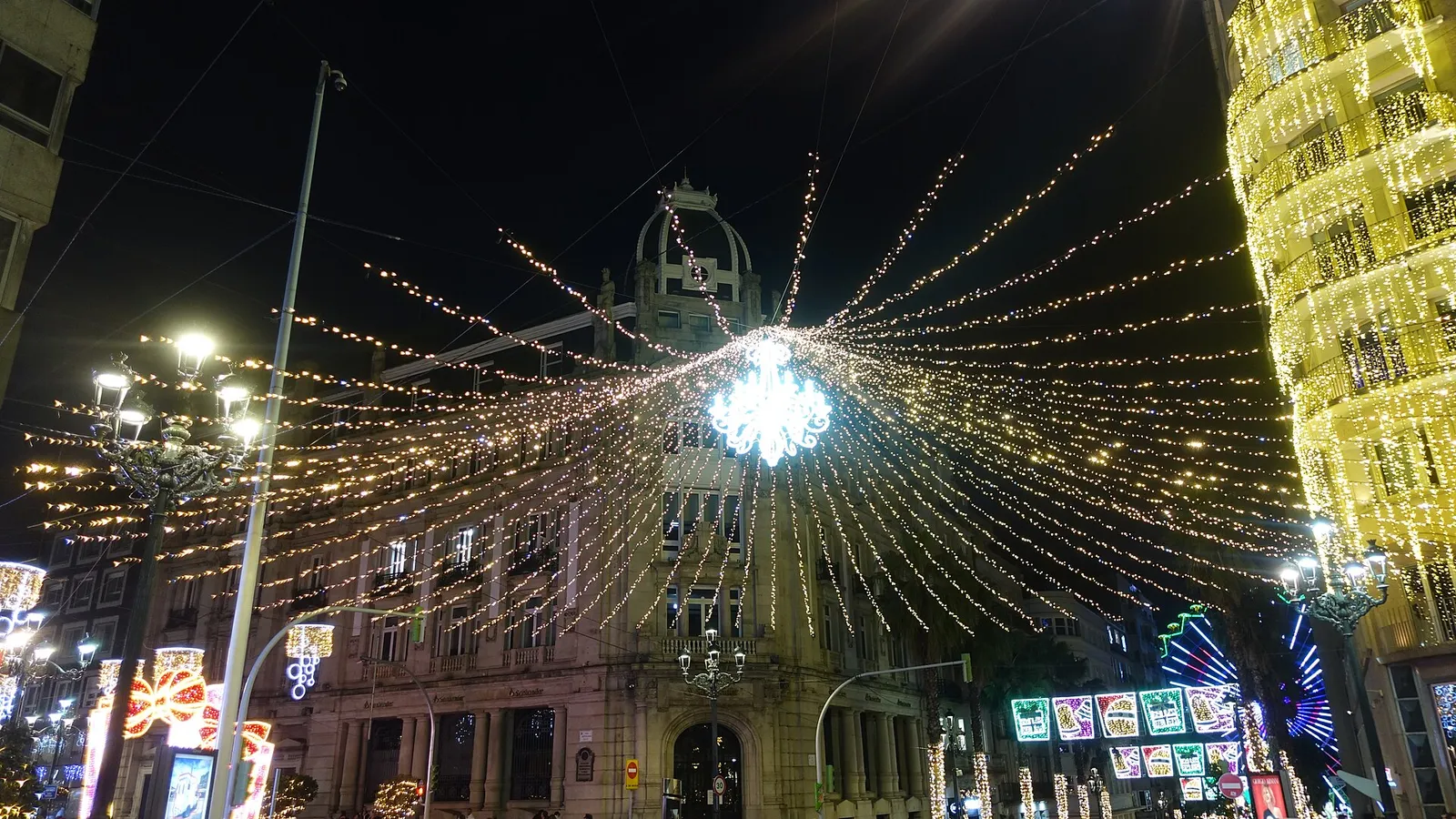
What is confirmed for 2026: installation began on 29 July, with about 500 streets, 12 million LED lights and more than 7,000 ornamental elements, and a budget of roughly 2.4 million euros (Diario de Pontevedra). The big tree is due on the Porta do Sol; last year it stood 45 metres tall. The mayor has confirmed the ferris wheel and the Cíes Market move to the Vialia area.
Until the date is official, book flexible transport, and pick a weekday after the switch-on if you can.
How do you get from Porto to Vigo?
Three options work for a day trip. Times and prices below are planning figures from route pages and aggregators, so confirm them with the operator on the day you travel.
| Option | Typical time | Cost signal | Day-trip fit |
|---|---|---|---|
| Car | About 1 hr 34 min, 147 km | Tolls about 13.75 EUR each way (see below) plus fuel | Flexible, but parking and traffic in Vigo are the hard part |
| Coach | About 2 hr to 2 hr 45 min | FlixBus pages list fares from about $13 to $17 | Several departures a day, late return possible |
| Celta train | About 2 hr 30 min, two trains a day | Aggregators estimate 21 to 35 EUR | Fixed morning and evening times, with a bus leg |
Source for the car and aggregator figures: Rome2rio. The Braga numbers come from Rome2rio.
What about the train from Porto to Vigo?
The Celta is the only direct rail service, and it has been disrupted. CP says Adif works mean all Celta trains (420, 421, 422 and 423) use a road transfer between Vigo-Guixar and Valença from 6 April 2026 to 7 April 2027, with no intermediate stops. CP states that current timetables are kept and arrival can vary with traffic (RTP). The replacement bus does not carry pets, wheelchairs, or bikes and scooters larger than 140 x 90 x 40 cm.
The last full timetable found is from August 2025, when CP also added a change at Viana do Castelo. It listed two trains each way (ECO):
- Porto Campanhã 08:13 to Vigo-Guixar 11:35 (Spanish time), and 19:10 to 22:34.
- Vigo-Guixar 08:58 to Porto Campanhã 10:20 (Portuguese time), and 19:56 to 21:18.
If those times still apply, the morning train gives you the afternoon in Vigo and the 19:56 return leaves after dark. The 2026 times, any Viana do Castelo change, and CP fares are not confirmed, so check the CP Celta page before you buy.
Is the bus a better choice than the train?
For flexibility, often yes. The FlixBus Porto to Vigo page lists about 2 hours 10 minutes and 8 trips a day, leaving from the Campanhã intermodal terminal, with the first departure at 02:10 and the last at 16:40. The Vigo to Porto page lists about 2 hours, 8 departures, and a last bus at 23:55. Fares are shown in US dollars, from about $13.48 outbound and $16.48 back. Rome2rio also lists Rede Expressos, BlaBlaCar Bus and Autna on the same corridor, at 2 hours 20 minutes to 2 hours 45 minutes.
Timetables change by day, so confirm the evening return before you commit.
How do you drive from Porto or Braga to Vigo?
From Porto, the route is the A3 north to Valença, across the Minho to Tui, then the Spanish A-55 or AP-9 to Vigo. Rome2rio puts it at about 147 km and 1 hour 34 minutes. From Braga the same route is about 99 km and 1 hour 12 minutes. Both are estimates in normal traffic, so add time for the Vigo approach on a lights evening.
The existing Galicia day trips guide covers the Valença to Tui crossing and rental car cross-border rules. If you need a transponder, see our Via Verde guide.
What do the tolls cost on each side of the border?
Portuguese side: simula.pt lists A3 Porto (Areosa) to Valença at 10.20 euros for a class 1 car in its 2026 table. That is a third-party simulator, so check the concessionaire if the exact figure matters. From Braga, the A3 stretch is shorter and cheaper, but sources disagreed on the exact amount and no official figure turned up.
Spanish side: Audasa’s 2026 tariff table lists Puxeiros to Tui at 3.55 euros for light vehicles, and Rande to Vigo/Puxeiros at 1.25 euros. Which sections you pay depends on the exit you take, and the parallel A-55 runs alongside the AP-9. Its toll status is not confirmed here, so check your route app.
Using the two figures above, a Porto round trip on the A3 and the AP-9 Puxeiros to Tui section would cost about 27.50 euros in tolls (2 x 10.20 + 2 x 3.55), before fuel and parking. Audasa also lists Vía-T discounts, but a Portuguese transponder only works in Spain if your Via Verde account has the Spain option, as covered in our Via Verde guide.
What is the time difference between Portugal and Spain?
Mainland Spain is one hour ahead of mainland Portugal, all year (Wikipedia: Time in Spain). Spain runs on Central European Time, Portugal on Western European Time, and both shift for daylight saving on the same dates.
In practice, a 20:00 switch-on is 19:00 on a Portuguese clock. Your phone may lag for a few minutes after crossing the Minho. A Porto departure at 08:13 arrives in Vigo at 11:35 on Spanish clocks, which is 10:35 in Portugal. Set your return alarms in Spanish time, because every Spanish timetable is.
Where do you park in Vigo during the lights?
Parking is the weak point for car visitors, and no official 2026 mobility plan has been published. What past editions show:
- In 2022 the Concello limited vehicles in the centre from 17:30 to midnight on weekends, holidays and the first full week of December (VigoÉ, 2022).
- In 2024, private cars needed a permit to enter the “zona cero”, and the mayor recommended visitors walk or take the bus (VigoÉ, 2024).
- The Christmas committee proposed lots at Samil, the Ifevi and the university campus in June 2024, and opposition councillors said they only work with frequent shuttles. The mayor suggested Samil. There is no 2026 confirmation.
- On Saturday 10 December 2022, access roads were jammed for hours, and police fined 17 vehicles parked at the Beiramar tunnel entrances (VigoÉ, 2022).
No published parking prices turned up. A safer plan on a peak evening is to park outside the centre or use the train or coach. For the pre-trip basics on Porto itself, see Living in Porto, and if you start from Braga see Living in Braga.
How bad are the crowds on 1 and 8 December and on weekends?
Expect the heaviest crowds on weekends and the early December holidays. In 2024, the Concello listed 36 days of expected high attendance: 16, 17, 22, 23, 24, 29 and 30 November; 1 to 8 December; 13 to 15 December; 20 to 31 December; and 1 to 6 January (VigoÉ, 2024). The list is from 2024, not 2026, but it shows how the Concello treats the season.
The 2026 calendar makes early December busier still. Portugal’s 1 December (Restoration of Independence) and 8 December (Immaculate Conception) are national holidays, per Postal. Both fall on a Tuesday in 2026 by calendar count. Spain’s 8 December is also a national holiday, listed for Tuesday in the 2026 BOE calendar. Portuguese visitors are visible in the traffic: a 2022 report called the arrival of Portuguese visitors a traffic collapse, and in 2024 a councillor said the main traffic problems came from tourists arriving by car from Portugal.
If you can, go on a Wednesday or Thursday evening. Skip 1 and 8 December and the weekends around them unless you are coming by train or coach.
What else should you plan for a Vigo day trip?
The lights only show after dark, so arrive in the afternoon, eat early and walk the lit streets after nightfall. Winter weather in Galicia is damp, so bring a waterproof layer.
Carry ID. There are no routine border checks inside Schengen, but hotels, rental desks and police may ask for a passport or residence card.
Fix your return before you arrive. The 19:56 Celta, a late FlixBus or your car park exit time should be fixed in advance, in Spanish time.
For other Portuguese Christmas plans, see Christmas in Porto, Christmas markets in Portugal, and the Christmas in Portugal overview. For the wider month, see Portugal in December, and for a road loop around the region see the north Portugal road trip.
Frequently asked questions
When are the Vigo Christmas lights switched on in 2026?
The date had not been announced as of 3 November 2026. Mayor Abel Caballero has called it the best kept secret, and local press has floated 13 or 14 November and the weekend of 20 to 22 November without confirmation. Last year's switch-on was reported for Saturday 15 November 2025. Watch the Concello de Vigo for the official date.
Is there a time difference between Porto and Vigo?
Yes. Mainland Spain is one hour ahead of mainland Portugal all year, because Spain uses Central European Time and Portugal uses Western European Time. Every Spanish train, bus and restaurant time is in Spanish time, so a 20:00 switch-on is 19:00 on a Portuguese clock.
Can I take the train from Porto to Vigo for the lights?
Yes, but with a bus leg. CP says the Celta has run with a road transfer between Valença and Vigo-Guixar from 6 April 2026 to 7 April 2027 because of Adif works, and the timetable was kept the same. The last timetable published lists two trains a day each way, so check CP before you book.
Is it better to drive or take the bus to Vigo at Christmas?
On the busiest evenings the bus or train is less stressful. Vigo has limited central parking, restricts car access to the centre on peak days, and past editions saw long queues on the main access roads. Driving is faster door to door and gives you a flexible return, so it suits quieter weekday visits.
Which days are busiest for the Vigo lights?
Weekends and the 1 to 8 December holiday stretch. In 2024 the Concello listed 36 high-attendance days, including 1 to 8 December and the late November weekends. Portugal and Spain both have a holiday on Tuesday 8 December 2026, and Portugal also has one on Tuesday 1 December, so expect crowds.
Do I need my passport to go to Vigo from Portugal?
There are no routine border checks between Portugal and Spain, since both are in the Schengen Area. Carry your passport or residence card anyway, because hotels, car rental desks and police may ask for ID.
Sources
This guide cites the following official sources. We link directly so you can verify every claim yourself.
- Hoxehoxe.vigo.org
- Eldebateeldebate.com
- Elespanolelespanol.com
- Diariodepontevedradiariodepontevedra.es
- Nosdiarionosdiario.gal
- RTPrtp.pt
- ECO (SAPO)eco.sapo.pt
- CP — Comboios de Portugalcp.pt
- Flixbusflixbus.com
- Flixbusflixbus.com
- Rome2riorome2rio.com
- Rome2riorome2rio.com
- Audasaaudasa.es
- Audasaaudasa.es
- Simulasimula.pt
- ENen.wikipedia.org
- Vigoevigoe.es
- Vigoevigoe.es
- Vigoevigoe.es
- Vigoevigoe.es
- Postalpostal.pt
- Garriguesgarrigues.com
Some links on this page are affiliate links. If you buy through them, we may earn a commission at no extra cost to you. How we research and update our guides