



On this page8 sections
- What actually happens on Christmas Eve in Portugal?
- How is Christmas in Portugal different from an American Christmas?
- Which December dates are public holidays and what closes?
- What’s the weather like in Portugal at Christmas?
- Where should you go for Christmas markets and lights?
- What does a Portuguese Christmas cost compared to the US?
- How do you handle Christmas as an American living in Portugal?
- What happens after Christmas Day?
Christmas in Portugal peaks on the night of December 24, not the morning of December 25. The main event is Consoada, a late Christmas Eve dinner built around boiled salt cod, followed by gifts opened at midnight. For the wider trip-planning picture, see our guide to Portugal in December, covering weather, costs and where to go. December 25 is a quiet public holiday for leftovers and family, and almost everything is shut.
If you’re American, that shift in timing changes your whole holiday plan. There is no Thanksgiving starting gun, no Black Friday-to-Christmas sprint, and no mountain of wrapped boxes under a tree. The season does not ramp up the way it does in the US. It arrives quietly, and then one evening the whole country is at a table eating cod.
The second thing that catches visitors out is closures. Restaurants routinely shut on the evening of the 24th and all day the 25th, because the staff are home with their own families. Supermarkets close on the 25th too. Plan food ahead or you’ll be eating vending machine crackers in a hotel room.
Key Takeaways: Consoada on December 24 is the main meal, traditionally bacalhau cozido com todos, or octopus in the north. Gifts open at midnight, brought by Menino Jesus or Pai Natal. December 25 is a public holiday; December 26 is not. December 1 and December 8 are also holidays. Expect rain, not snow, and temperatures around 46 to 59 degrees Fahrenheit in Lisbon.
What actually happens on Christmas Eve in Portugal?
Consoada is the Christmas Eve dinner, eaten late, often starting somewhere between 8 and 10 p.m. and stretching past midnight. The centerpiece is bacalhau cozido com todos: boiled salt cod served with potatoes, cabbage or couve, hard-boiled eggs, and a heavy drizzle of good olive oil at the table. There is no glaze, no crust, and no long list of side dishes.
The dish is simple because it was historically a meatless vigil meal, and the flavor comes from the quality of the cod and the oil. In the north, plenty of families do polvo instead, octopus boiled the same way with the same accompaniments. Some northern households consider the cod version a Lisbon habit.
Then come the desserts, where the table stops being modest. Rabanadas are essentially Portuguese French toast soaked in wine syrup or sugar and cinnamon. Filhoses and sonhos are both fried dough, aletria is a sweet vermicelli pudding dusted with cinnamon, and arroz doce is sweet rice pudding with cinnamon patterns drawn on top. Bolo rei is the candied fruit ring cake with a dried fava bean hidden inside, and whoever bites the bean buys next year’s cake. If you don’t like candied fruit, buy bolo rainha instead, which swaps in nuts.
Gifts open at midnight rather than the next morning. Kids stay up, and the tradition credits Menino Jesus, the baby Jesus, as the gift-bringer, though Pai Natal has muscled in over the last few decades and most children now accept both explanations. If you want more context on how Portuguese food logic works year-round, our guide to Portuguese food covers the staples you’ll keep meeting.
How is Christmas in Portugal different from an American Christmas?
The differences are structural. Portugal has no Thanksgiving, so there’s no cultural starting pistol in late November. Decorations go up, municipal lights switch on, and the season simply exists. Gift volume is far lower and gift-giving is mostly for children. Adults often exchange one modest thing or nothing at all.
| Element | United States | Portugal |
|---|---|---|
| Season kickoff | Day after Thanksgiving | Early December, no fixed trigger |
| Main meal | Dec 25 lunch or dinner | Consoada, late Dec 24 |
| Centerpiece dish | Turkey, ham, roast beef | Boiled salt cod, or octopus in the north |
| Gift timing | Dec 25 morning | Midnight on Dec 24 |
| Gift-bringer | Santa Claus | Menino Jesus, increasingly Pai Natal |
| Gift scale | Large, all ages | Modest, mostly children |
| Focal decoration | Tree | Presépio (nativity scene) |
| Dec 26 | Return-and-sale day | Ordinary working day |
| Season ends | New Year’s Day | Jan 6, Dia de Reis |
Trees are everywhere now, but the nativity scene is the older and more emotionally loaded decoration. Churches, town halls, shop windows and living rooms all build them, some sprawling across an entire table with moss, cork bark and tiny running water. Braga and the northern towns go hard on this.
There is also no Boxing Day. December 26 is a normal working Saturday or weekday. Shops open, offices open, nobody is queuing for returns. Portugal’s official public holiday calendar is published by the government at portugal.gov.pt, and it’s worth checking each year because some municipal holidays move.
Which December dates are public holidays and what closes?
Portugal has three December public holidays that affect visitors: December 1 (Restoration of Independence), December 8 (Immaculate Conception), and December 25. Each one closes banks, public offices and many shops. December 24 and December 31 are normal working days on paper, but in practice half the country clocks out early.
| Date | Status | What to expect |
|---|---|---|
| Dec 1 | Public holiday | Banks and offices closed, malls open, museums vary |
| Dec 8 | Public holiday | Same as above, busy shopping weekend if it falls well |
| Dec 24 | Working day | Shops close early afternoon, most restaurants shut by evening |
| Dec 25 | Public holiday | Supermarkets closed, most restaurants closed, reduced transport |
| Dec 26 | Normal day | Everything reopens, no Boxing Day |
| Dec 31 | Working day | Early closures, city squares fill at night |
| Jan 1 | Public holiday | Very quiet morning, late openings |
| Jan 6 | Not a holiday | Dia de Reis celebrated, but shops and offices open |
Last checked: 3 November 2026. Weekdays for 2026: December 1 and 8 fall on Tuesdays, and December 25 is a Friday. For supermarket, pharmacy, museum and transport hours by day, see what’s open on Christmas Day in Portugal.
Transport thins out badly on the 25th. Trains run a reduced Sunday-style timetable and intercity services book out days ahead as people travel home to family; check schedules directly with Comboios de Portugal rather than trusting a third-party app. Urban buses drop to skeleton service. If you’re landing on Christmas Eve, arrange your transfer in advance.
Do the big shop on December 23. The supermarkets on the 24th are a contact sport, and our breakdown of Portuguese supermarkets will tell you which chains to aim for. Buy the bolo rei from a pastelaria, not the supermarket shelf, if you want to understand why people care about it.
What’s the weather like in Portugal at Christmas?
Mild and wet, not white. Lisbon in December typically sits between roughly 46 and 59 degrees Fahrenheit (8 to 15 Celsius). Porto runs a few degrees cooler and noticeably rainier. The Algarve stays the mildest and driest of the mainland. The interior north can drop below freezing overnight. Official climate normals and December forecasts come from IPMA, Portugal’s national weather institute.
Snow is not part of the picture unless you drive up to Serra da Estrela, the only mainland range that reliably gets it. Everywhere else, December means rain, wind off the Atlantic, and short days. Sunset in Lisbon lands around 5:15 p.m., earlier in Porto.
Portuguese buildings are cold inside, and visitors often underestimate it. Central heating is uncommon in older housing stock, and stone walls hold damp. An apartment at 55 degrees indoors with no heat feels far worse than a dry 30-degree day in Chicago. Pack layers you’d wear indoors, and if you’re booking accommodation, filter specifically for heating rather than assuming it. Our winter guide to Portugal goes deeper on what to actually pack.
If you’re weighing December against a shoulder-season trip, October in Portugal gives you warm sea and thin crowds, and September is arguably the best month of the year for weather. December wins on atmosphere and price, and loses on daylight.
Where should you go for Christmas markets and lights?
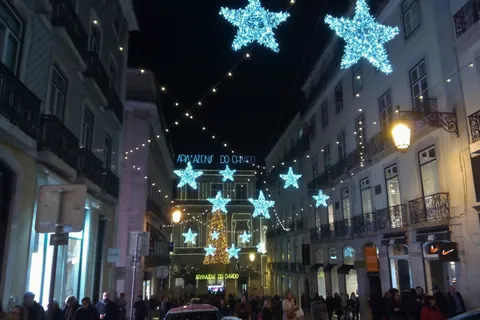
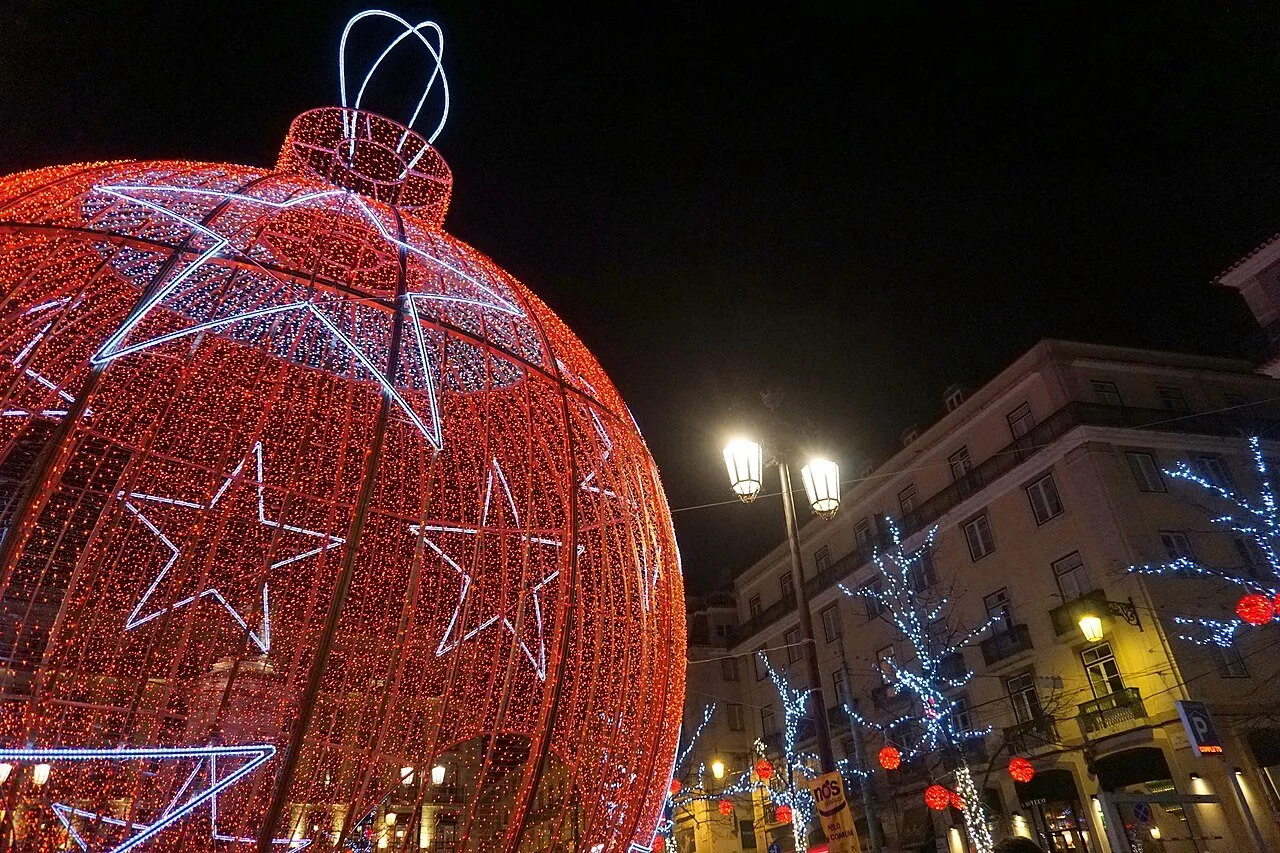
Lisbon and Porto carry the biggest free displays: Rossio, Praça do Comércio and the riverfront tree in Lisbon, and the Avenida dos Aliados light show in Porto. Our guides to Christmas in Lisbon and Christmas in Porto cover each city.
Óbidos Vila Natal runs from 27 November 2026 to 3 January 2027, and the official ticket page lists €12 for adults and €8 for children aged 3 to 11 (Óbidos Vila Natal). It is closed on 25 December and 1 January. The Óbidos Vila Natal guide covers tickets, sessions and getting there.
Dates, prices and the northern towns are in the Christmas markets in Portugal guide. Staying in Porto? The Vigo Christmas lights day trip crosses into Galicia for Vigo’s Christmas lights.
What does a Portuguese Christmas cost compared to the US?
Considerably less, mainly because the gift culture is smaller. A full Consoada spread for six, cooked at home with good cod, sides, wine and two desserts, lands somewhere around $70 to $110 (~€60 to €95). Restaurant Christmas menus, where offered, tend to run higher. Consumer price data for food and hospitality is published by the Instituto Nacional de Estatística, and inflation context by the Banco de Portugal.
The bigger savings are in gifts. Portuguese families typically buy for children and maybe one adult exchange, rather than the American pattern of buying for everyone including coworkers. For a fuller picture of what daily spending looks like here, see our cost of living breakdown for expats.
| Item | Typical cost |
|---|---|
| Good salt cod, per person | $9 to $14 (~€8 to €12) |
| Bolo rei from a pastelaria | $14 to $23 (~€12 to €20) |
| Bottle of decent Douro red | $8 to $17 (~€7 to €15) |
| Óbidos Vila Natal, adult ticket | ~$14 (€12) |
| Roast chestnuts, street cone | $3 to $5 (~€3 to €4) |
Accommodation is where the season bites. Lisbon and Porto hotel rates climb sharply between December 28 and January 2 for New Year, while the week before Christmas is often one of the cheapest of the year. Book the Christmas week early anyway, because inventory is thin rather than expensive. And if you’re flying in over the holidays, travel insurance is worth more than usual in December, when Atlantic storms cause flight disruption.
How do you handle Christmas as an American living in Portugal?
Do both, staggered. Cook your own turkey or ham on December 25, when the Portuguese are eating leftovers, and join the Consoada tradition on the 24th. The calendar has room for both meals, which is a genuine advantage.
The hard part is the quiet: December here is quieter than you’re used to, and that can read as lonely if you’re not expecting it. There’s no ambient office-party season, no neighborhood light competitions, no constant background hum of holiday commerce.
Get invited to a Consoada if you possibly can. Portuguese families are generous about including foreigners who are on their own, and one evening at a family table teaches you a lot about the country. Bring wine and something sweet. Don’t bring a gift for the adults, since it creates awkwardness.
If you’d rather eat out, book weeks ahead, because the handful of places that do open fill fast. Hotel restaurants and larger city venues are your best bet, and our roundup of Lisbon’s best restaurants for 2026 flags the ones that historically stay open through the holidays. Call to confirm, because websites are often wrong about holiday hours.
What happens after Christmas Day?
The season runs to January 6, Dia de Reis, which is when Portugal’s Christmas ends. It’s not a public holiday, but it carries real traditions: groups go door to door singing Janeiras and Reisadas, folk songs asking for treats and small offerings, and the bolo rei is traditionally eaten through this whole stretch rather than just on the 25th.
New Year’s Eve, called Passagem de Ano, is a bigger public street event than Christmas is. Madeira’s Funchal fireworks display is the famous one, but Lisbon, Porto and most coastal towns run free concerts and midnight fireworks in their main squares. The tradition is eating twelve raisins at midnight, one per chime, each with a wish.
Decorations often stay up until Reis. Taking the tree down before January 6 is considered slightly unlucky by older generations, unlike the American instinct to have everything boxed by December 27.
Frequently asked questions
Is December 26 a holiday in Portugal?
No. Unlike the UK and Ireland, Portugal has no Boxing Day. December 26 is a normal working day, with shops, offices and transport running standard schedules. Only December 1, December 8 and December 25 are December public holidays nationally, plus January 1. Regional and municipal holidays occasionally add local closures, so check your specific town.
Do restaurants open on Christmas Day in Portugal?
Most don’t. The majority close from the evening of December 24 through all of December 25 so staff can be with family. Hotel restaurants and some larger city venues stay open with set menus, but they book out well in advance. Supermarkets are closed on December 25, so shop by December 23 at the latest.
Do Portuguese children believe in Santa Claus?
Both, increasingly. The traditional gift-bringer is Menino Jesus, the baby Jesus, and older generations still frame it that way. Pai Natal, the Portuguese Santa, arrived through television and advertising and is now equally familiar to most kids. Either way, gifts are opened at midnight on December 24, not on Christmas morning.
Does it snow in Portugal at Christmas?
Almost never outside Serra da Estrela, the only mainland range that gets reliable snowfall. Expect rain instead. Lisbon runs roughly 46 to 59 degrees Fahrenheit in December, Porto cooler and wetter, and the Algarve mildest. The interior north can freeze overnight, but coastal cities stay damp and green rather than white.
What is bolo rei and why is there a bean in it?
Bolo rei is a ring-shaped cake studded with candied fruit and nuts, eaten from December through Dia de Reis on January 6. A dried fava bean is hidden inside, and whoever finds it in their slice traditionally buys next year’s cake. If candied fruit isn’t your thing, bolo rainha uses only nuts.
Is Christmas a good time to visit Portugal?
Yes, if you want atmosphere over beach weather. Cities are lit, crowds are thinner than summer, and prices in the week before Christmas are among the year’s lowest. The tradeoffs are short daylight, likely rain and widespread closures on December 25. Book accommodation with confirmed heating, and confirm restaurant hours by phone.
Sources
This guide cites the following official sources. We link directly so you can verify every claim yourself.
- Obidosvilanatalobidosvilanatal.pt
- CM Obidoscm-obidos.pt
- Governo de Portugalportugal.gov.pt
- CP — Comboios de Portugalcp.pt
- IPMA — Instituto Português do Mar e da Atmosferaipma.pt
- Visit Portugalvisitportugal.com
- INE — Instituto Nacional de Estatísticaine.pt
- Banco de Portugalbportugal.pt
Some links on this page are affiliate links. If you buy through them, we may earn a commission at no extra cost to you. How we research and update our guides